Introduction
Digital payments have become an essential part of modern business. From mobile wallets and online marketplaces to subscription platforms and point-of-sale systems, customers expect fast, convenient, and secure payment experiences.
However, building a payment application in 2026 involves more than integrating a payment gateway. Businesses must consider sensitive data protection, authentication, fraud prevention, third-party integrations, and evolving payment security requirements.
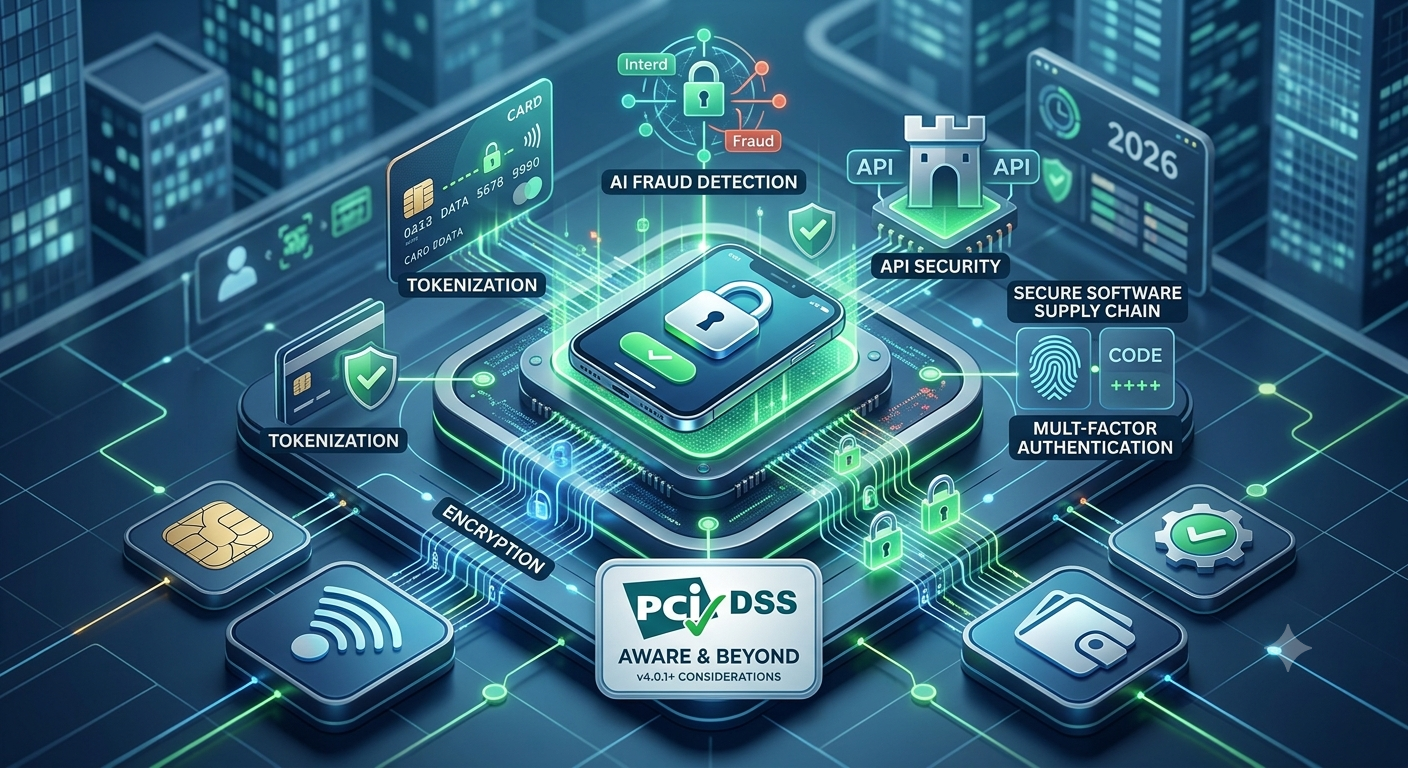
The Payment Card Industry Data Security Standard (PCI DSS) provides a framework for protecting payment card data. PCI DSS v4.0.1 is an important reference for organizations that store, process, transmit, or can affect the security of payment account data.
For businesses planning a new payment product, the challenge is clear: how can you create a smooth payment experience without compromising security?
This guide explores the key technologies, security practices, and development decisions behind modern payment applications.
1. What Is Payment Application Development?
Payment application development involves designing and building software that enables businesses or customers to initiate, process, manage, or monitor payments.
Depending on the business model, a payment application may include:
- Online checkout and payment processing.
- Mobile wallet and digital payment features.
- Recurring billing and subscription management.
- Transaction histories and digital receipts.
- Refunds, cancellations, and dispute workflows.
- Fraud monitoring and suspicious-activity alerts.
- Payment gateway and banking integrations.
- Merchant dashboards and reconciliation tools.
Payment applications may interact with payment processors, acquiring banks, issuing banks, card networks, and third-party service providers. The architecture must clearly define which systems handle sensitive payment information and which security obligations apply to each component.
2. PCI DSS v4.0.1: Why Compliance Matters
PCI DSS establishes technical and operational requirements designed to protect payment account data. Version 4.0.1 clarified requirements without introducing an entirely new standard.
For payment application developers, PCI DSS considerations should influence system architecture, development practices, infrastructure, and testing from the beginning.
Important areas include:
Protecting Cardholder Data
Avoid storing sensitive authentication data after authorization. Store only permitted data when there is a legitimate business need, and apply appropriate protections to any stored cardholder data.
Secure Software Development
Follow secure coding practices, conduct code reviews, manage vulnerabilities, and test applications for security weaknesses throughout the development lifecycle.
Access Control
Restrict administrative and technical access according to job responsibilities. Use strong authentication and monitor privileged accounts.
Logging and Monitoring
Maintain appropriate audit logs, protect them against unauthorized modification, and monitor systems for suspicious activity.
Vulnerability Management
Keep dependencies, operating systems, frameworks, and other components updated. Identify and remediate vulnerabilities based on their severity and business risk.
Important: Using a payment gateway does not automatically make every business or application PCI DSS compliant. Scope depends on the implementation, system connectivity, provider arrangements, and applicable requirements. Confirm compliance obligations with a qualified assessor or the relevant payment partners.
3. Tokenization: Reduce Exposure to Payment Card Data
Tokenization replaces a payment card number with a token that can be used in supported payment workflows.
For example, an online store may use a payment provider’s hosted checkout or tokenization service instead of directly collecting and storing card numbers on its own servers.
A simplified payment flow looks like this:
Customer → Secure Checkout → Payment Provider → Token or Payment Reference → Merchant Application
Depending on the provider and implementation, this approach can reduce the amount of sensitive card data handled by the merchant’s systems.
Benefits may include:
- Reduced exposure of cardholder data.
- Simplified recurring payment workflows.
- Lower risk associated with storing card numbers.
- Easier integration with supported payment services.
- Potentially reduced PCI DSS scope, subject to validation.
Tokenization is not a substitute for security controls. Developers must still protect application credentials, APIs, user sessions, and the systems that interact with payment services.
4. AI-Powered Fraud Detection in Payment Applications
Artificial intelligence and machine learning can help identify unusual transaction patterns and prioritize potentially fraudulent activity.
A fraud detection system may evaluate signals such as transaction frequency, device characteristics, account history, location inconsistencies, and unusual purchasing behavior, subject to applicable privacy and legal requirements.
Possible applications include:
- Detecting unusual transaction patterns.
- Identifying suspicious account activity.
- Flagging repeated payment attempts.
- Supporting risk-based authentication.
- Prioritizing transactions for manual review.
- Monitoring anomalies across merchant accounts.
AI should complement established security controls rather than replace them. Models need appropriate training data, ongoing evaluation, false-positive monitoring, and safeguards against manipulation.
For high-risk transactions, a payment application may combine automated risk scoring with additional verification or manual review.
5. Essential Security Features Every Payment App Should Consider
A secure payment application requires multiple layers of protection.
Multi-Factor Authentication
Use appropriate authentication mechanisms for sensitive accounts and administrative functions. Apply additional verification when the risk of account compromise is elevated.
Encryption
Use current, secure transport encryption and appropriate cryptographic controls for sensitive information. Manage encryption keys carefully and restrict access to them.
API Security
Authenticate and authorize API requests, validate inputs, enforce rate limits, and protect credentials. Avoid exposing sensitive information through error messages or application logs.
Secure Session Management
Use secure session handling, appropriate expiration policies, and protection against session theft and unauthorized reuse.
Fraud and Abuse Monitoring
Monitor unusual payment attempts, suspicious account behavior, and repeated failures. Establish clear procedures for investigating alerts.
Secure Software Supply Chain
Review third-party libraries and payment integrations. Track dependencies, patch known vulnerabilities, and verify that external components are maintained.
Payment Page Security
Protect browser-based payment flows against unauthorized script changes and other attacks. Apply relevant controls for payment-page scripts and tampering risks under applicable PCI DSS requirements.
6. Choosing the Right Payment App Architecture
The architecture of a payment application depends on the product, transaction volume, security requirements, and integration complexity.
Three common approaches are:
Hosted checkout: Customers enter payment details on a payment provider’s hosted page. This can reduce direct handling of card data.
Provider-hosted fields: A provider supplies payment fields that integrate into the merchant’s checkout interface. Scope and security responsibilities depend on the exact implementation.
Custom payment interface: Businesses build a more tailored payment experience and integrate with a processor or gateway. This offers flexibility but can introduce additional development, testing, and compliance responsibilities.
When designing the architecture, evaluate:
- Expected transaction volume.
- Supported currencies and payment methods.
- Refunds and recurring payments.
- Integration with existing business systems.
- Availability and disaster recovery.
- Data retention and privacy requirements.
- PCI DSS scope and validation requirements.
The most suitable architecture is the one that satisfies business requirements while minimizing unnecessary security exposure and operational complexity.
7. A Practical Payment App Development Roadmap
A structured development process helps reduce security gaps and costly redesigns.
Step 1: Define requirements
Document payment methods, supported markets, user journeys, transaction flows, and compliance obligations.
Step 2: Map payment data flows
Identify where cardholder data enters, moves through, and leaves the system. Determine which components belong in or can affect the PCI DSS scope.
Step 3: Select payment integrations
Evaluate payment providers based on supported features, security capabilities, documentation, commercial terms, and geographic coverage.
Step 4: Design the architecture
Plan authentication, authorization, encryption, logging, secrets management, and failure handling before implementation.
Step 5: Develop core features
Build checkout, transaction management, refunds, receipts, notifications, and administrative tools according to the product requirements.
Step 6: Test security and reliability
Perform code reviews, dependency checks, security testing, and payment-flow testing. Verify how the application handles timeouts, duplicate requests, declined transactions, and interrupted connections.
Step 7: Validate compliance and launch
Complete the applicable PCI DSS assessment and validation activities, coordinate with payment partners, and establish ongoing monitoring and maintenance.
8. How Much Does Payment App Development Cost?
Payment application development costs vary according to the required features, target platforms, payment integrations, security controls, and compliance needs.
A basic payment-enabled application may be relatively straightforward when it relies on a provider’s existing checkout capabilities. A custom platform with merchant management, recurring billing, complex integrations, fraud analytics, and extensive security testing requires substantially more work.
Major cost factors include:
- iOS, Android, web, or cross-platform development.
- Payment gateway integration.
- Backend architecture and infrastructure.
- Authentication and fraud prevention.
- Security audits and compliance assessment.
- Third-party integrations.
- Ongoing updates and monitoring.
Request an estimate based on a documented scope, including the payment data flow, integrations, testing requirements, and ongoing support.
9. Why Choose a Specialized Payment App Development Partner?
Payment software combines user experience, financial integrations, secure engineering, and regulatory considerations. A development partner should understand how these areas affect one another.
Look for experience in:
- Payment gateway and processor integrations.
- Secure mobile and web application development.
- PCI DSS-aware architecture.
- Tokenization and recurring payment workflows.
- API security and authentication.
- Fraud monitoring and transaction risk controls.
- Security testing and vulnerability remediation.
- Production support and ongoing maintenance.
Ask potential partners how they minimize card-data exposure, manage third-party dependencies, test payment failures, and coordinate compliance responsibilities.
At PCIAppDeveloper, the focus is on helping businesses plan and develop payment applications with security, integration requirements, and long-term maintainability in mind.
Frequently Asked Questions
What is PCI DSS in payment app development?
PCI DSS is a security standard designed to protect payment account data. Its requirements apply according to an organization’s role, systems, payment data flows, and other relevant factors.
Does every payment app need PCI DSS compliance?
Not every application has the same compliance obligations. Requirements depend on whether the business stores, processes, or transmits cardholder data, or can affect the security of the cardholder data environment. Businesses should confirm their applicable obligations with their acquiring bank, payment provider, or qualified assessor.
Is tokenization enough to secure a payment application?
No. Tokenization can reduce exposure to cardholder data, but applications still need secure authentication, access control, API protection, monitoring, vulnerability management, and other appropriate safeguards.
Can AI prevent payment fraud completely?
No. AI can help identify suspicious patterns, but it cannot eliminate fraud. Effective fraud prevention combines analytics with authentication, transaction controls, monitoring, and incident-response procedures.
How long does it take to develop a payment app?
The timeline depends on the number of platforms, payment methods, integrations, security requirements, and testing activities. A provider-integrated application may be simpler than a custom payment platform with advanced risk management and merchant administration.
Conclusion
Building a payment application in 2026 requires a balance of convenience, reliability, security, and compliance. PCI DSS considerations, tokenization, secure APIs, appropriate authentication, and continuous vulnerability management should be incorporated into the development process from the start.
AI-based analytics can provide additional support for fraud monitoring, while carefully selected payment integrations can reduce unnecessary exposure to sensitive card data.
For businesses planning a new payment product or modernizing an existing platform, the best starting point is a clear understanding of payment flows, security responsibilities, and user requirements.
Planning a secure payment application? Connect with PCIAppDeveloper to discuss payment app development, integrations, and security-focused software architecture.
SEO Details
- SEO title: Payment App Development in 2026: PCI DSS & Security Guide
- Meta description: Learn how to build secure payment apps in 2026 with PCI DSS considerations, tokenization, AI fraud detection, API security, and payment gateway integration.
- Primary keyword: Payment app development
- Secondary keywords: PCI DSS compliance, PCI compliant app development, payment application development, secure payment gateway integration, payment app security, AI fraud detection.
- Suggested URL slug:
/payment-app-development-security-guide/
Comments