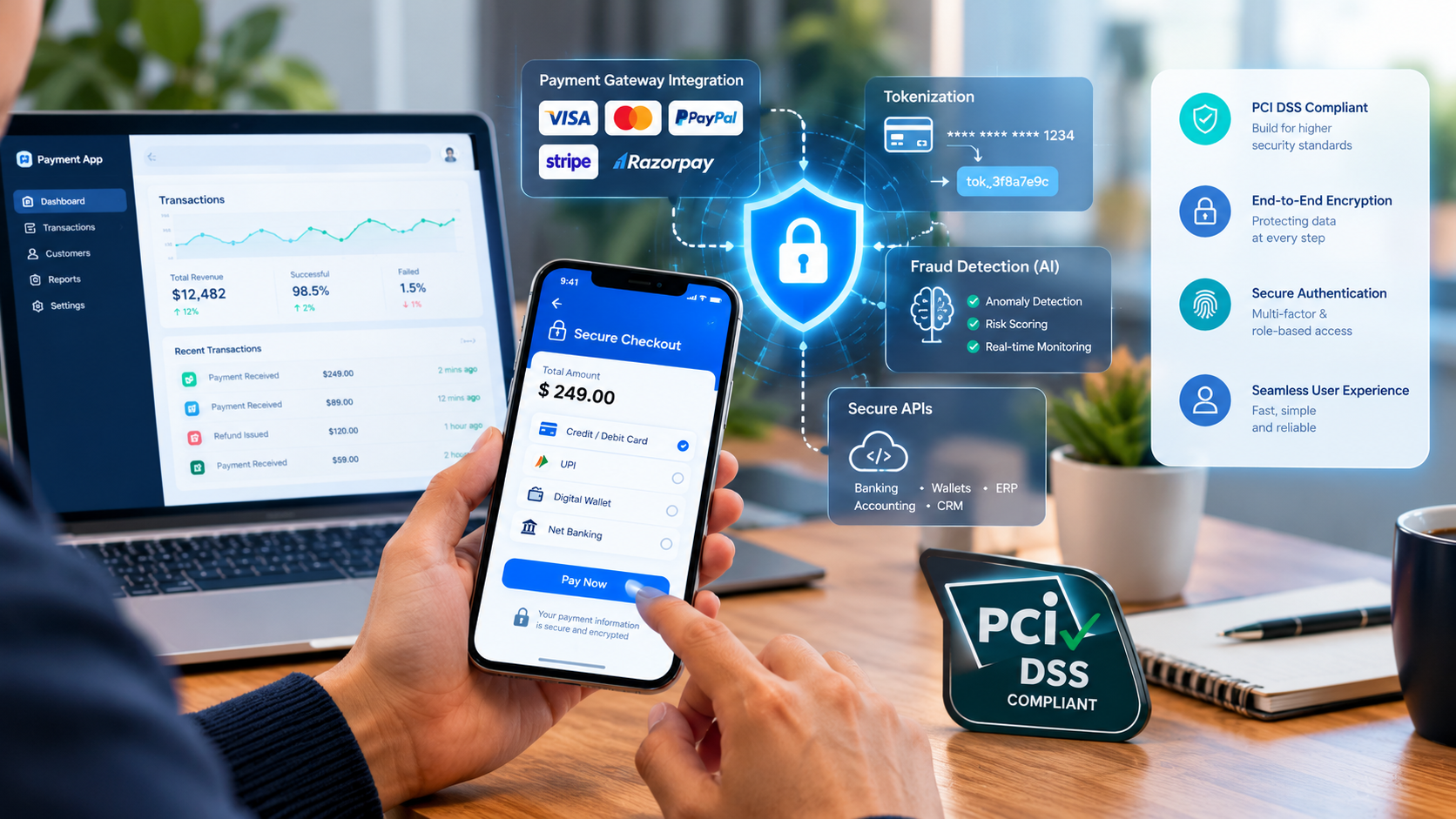
Digital payments are becoming an essential part of modern business. From mobile wallets and online shopping to subscription platforms and financial applications, businesses need payment systems that are secure, reliable, and easy to use.
In 2026, payment app development is about more than processing transactions. Businesses must also consider data protection, fraud prevention, regulatory requirements, and customer trust.
A well-designed payment application combines secure architecture, reliable payment gateway integrations, appropriate compliance controls, and a seamless checkout experience.
What Is Payment App Development?
Payment app development is the process of designing and building software that allows users and businesses to initiate, process, manage, or track digital payments.
Depending on the business model, a payment application may include:
- Credit and debit card payment integration
- Digital wallet functionality
- Payment gateway integration
- Recurring and subscription payments
- Transaction history and reporting
- Refund and settlement workflows
- Fraud monitoring and risk controls
- Secure user authentication
- PCI DSS-aligned security controls
The specific requirements depend on whether the application stores, processes, transmits, or avoids handling payment card data.
Why PCI DSS Compliance Matters in 2026
The Payment Card Industry Data Security Standard (PCI DSS) establishes security requirements for protecting payment account data. PCI DSS v4.0.1 is an important reference for organizations that store, process, or transmit cardholder data, as well as other entities within the applicable compliance scope.
Compliance is not simply a feature added at the end of development. Security needs to be considered throughout the application lifecycle.
Important areas include:
- Protecting payment account data
- Maintaining secure system configurations
- Applying appropriate access controls
- Monitoring and logging relevant activity
- Managing vulnerabilities and security updates
- Testing security controls regularly
- Protecting payment pages and payment integrations
Businesses should determine their specific compliance obligations with their acquiring bank, payment brands, and qualified compliance professionals.
Essential Security Features for Payment Applications
1. Tokenization
Tokenization replaces sensitive payment card details with a token that can be used within an approved payment workflow.
When implemented through a suitable payment provider, tokenization can reduce the amount of sensitive card data handled by a business’s application. It does not automatically eliminate PCI DSS responsibilities.
2. Strong Authentication
Payment applications should use appropriate authentication and authorization mechanisms to prevent unauthorized access.
Depending on the application, security measures may include multifactor authentication, secure session management, transaction verification, and role-based permissions.
3. Encryption and Secure Communication
Sensitive information should be protected using appropriate encryption and secure communication protocols. Encryption keys must also be managed carefully.
Security design should cover data in transit, relevant data at rest, application secrets, and integrations with external payment providers.
4. Fraud Detection and AI-Assisted Monitoring
AI and machine learning can help identify unusual transaction patterns, suspicious account activity, and potentially fraudulent behavior.
However, automated systems can generate false positives and miss some threats. Businesses should combine risk models with appropriate verification, monitoring, human review, and incident-response processes.
5. Secure APIs and Payment Gateway Integration
Payment applications often communicate with payment gateways, banking services, accounting platforms, and other business systems.
Secure API design should include appropriate authentication, authorization, input validation, rate limiting, secret management, and logging. Webhook events should also be authenticated and handled safely to reduce the risk of forged or duplicated transactions.
Payment App Development Trends in 2026
AI-Assisted Fraud Prevention
Intelligent monitoring can help businesses prioritize suspicious transactions and identify patterns that rule-based systems may overlook.
Digital Wallet Integration
Supporting established digital wallets can make checkout faster and more convenient, depending on the target market and payment provider.
Biometric Authentication
Biometric features supported by a device can simplify user verification. They should be implemented through secure platform mechanisms rather than storing raw biometric information unnecessarily.
Contactless and Mobile Payments
Businesses are exploring contactless payment experiences, mobile point-of-sale solutions, and integrations that make in-person and online payments more connected.
Automated Compliance Monitoring
Security monitoring, vulnerability management, access reviews, and evidence collection can help teams maintain visibility into their controls. Automation supports compliance activities but does not guarantee compliance by itself.
How to Build a Secure Payment Application
A structured development process helps businesses balance functionality, security, and usability.
Step 1: Define the payment model. Identify the target users, supported payment methods, transaction flows, countries, and business requirements.
Step 2: Select the right architecture. Decide which components will be developed in-house and which will be handled by established payment service providers.
Step 3: Establish the compliance scope. Evaluate the application’s interaction with payment account data and identify the applicable PCI DSS requirements.
Step 4: Develop and integrate securely. Implement authentication, encryption, secure APIs, transaction controls, and payment gateway integrations.
Step 5: Test the application. Perform functional testing, security assessments, integration testing, and appropriate vulnerability testing before launch.
Step 6: Monitor and maintain. Keep software updated, monitor relevant events, manage vulnerabilities, and review security controls as the application evolves.
How to Choose a Payment App Development Company
Choosing an experienced development partner can help businesses address technical complexity and security requirements.
Before selecting a provider, consider:
- Experience with payment applications and gateway integrations
- Understanding of PCI DSS requirements and compliance boundaries
- Secure software development and testing practices
- Experience with APIs, tokenization, and transaction workflows
- Documentation and deployment processes
- Ongoing maintenance and security support
A development company should be transparent about its experience and should not promise PCI DSS compliance merely because it implements a few security features.
Conclusion
Secure payment app development in 2026 requires a balanced approach to functionality, user experience, data protection, and compliance.
Businesses that plan security early, use appropriate payment integrations, and maintain their systems consistently are better positioned to build reliable digital payment experiences.
PCIAppDeveloper can use these principles to help businesses explore secure payment application architecture, payment gateway integration, and PCI DSS-aware development strategies tailored to their requirements.
Frequently Asked Questions
What is PCI DSS in payment app development?
PCI DSS is a security standard designed to protect payment card account data. Applicable requirements depend on the organization’s role and payment environment.
Does using a payment gateway remove PCI DSS requirements?
No. A third-party payment gateway may reduce the scope of a business’s card-data environment, but the business may still have applicable PCI DSS responsibilities.
What programming technologies are used for payment app development?
Technology choices vary by project and may include Swift, Kotlin, cross-platform mobile frameworks, backend languages, databases, and secure payment APIs.
Can AI prevent payment fraud?
AI can help detect suspicious patterns and support fraud-risk decisions, but it cannot eliminate fraud. Effective prevention combines multiple security controls and ongoing monitoring.
How much does payment app development cost?
Costs depend on supported platforms, payment methods, security requirements, integrations, testing, and ongoing maintenance. A detailed scope is needed for a reliable estimate.
Comments