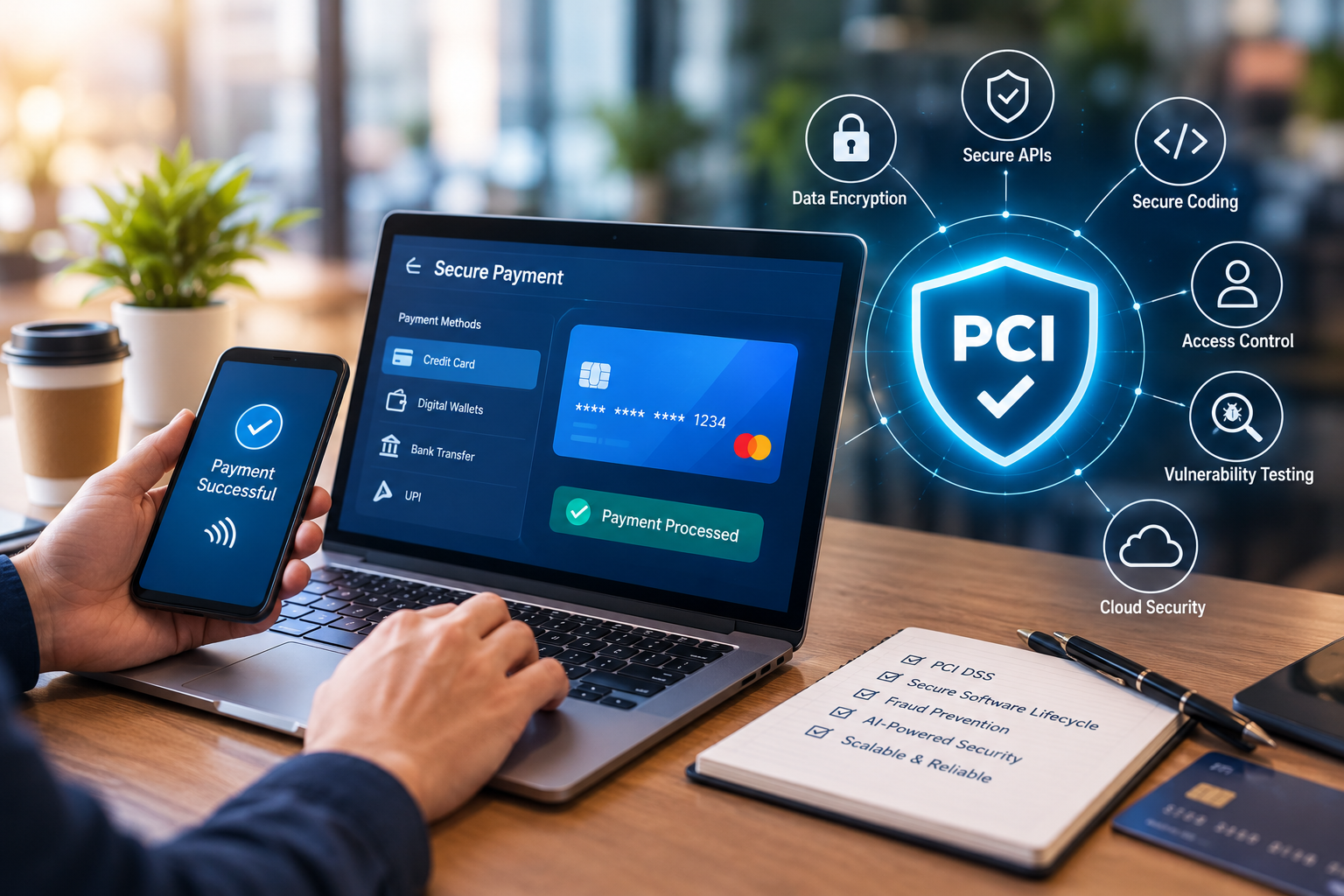
Payment applications are becoming more intelligent, connected, and feature-rich. Businesses now expect payment software to support mobile transactions, digital wallets, APIs, cloud infrastructure, recurring payments, analytics, and AI-powered experiences.
But as payment technology evolves, security cannot be treated as a final-stage checklist.
In 2026, payment application development requires a security-first approach throughout the software lifecycle—from architecture and coding to testing, deployment, monitoring, and maintenance.
The PCI Security Standards Council (PCI SSC) continues to evolve its software security framework. In September 2026, PCI SSC released version 2.0 of the PCI Secure Software Lifecycle Standard, introducing updated requirements around secure lifecycle practices, sensitive assets, and digital tools, including considerations for AI.
For businesses building payment applications, understanding these developments can help create software that is more secure, resilient, and prepared for evolving payment threats.
What Is PCI-Compliant Payment Application Development?
PCI-compliant payment application development refers to designing and developing payment software with security controls that help protect payment transactions and payment card data.
Depending on the application’s architecture and role in the payment environment, development teams may need to consider areas such as:
- Secure application architecture
- Authentication and authorization
- Encryption
- Secure API communication
- Access control
- Vulnerability management
- Secure coding practices
- Logging and monitoring
- Data protection
- Software lifecycle security
- Third-party components
- Security testing
PCI SSC’s Secure Software Standard is specifically designed for software vendors and developers creating payment software and focuses on protecting payment transactions and payment card data.
PCI DSS and Secure Software Are Not the Same Thing
One important distinction for businesses is the difference between PCI DSS and the PCI Secure Software Standard.
PCI DSS focuses broadly on entities that store, process, or transmit payment card data and other entities that can affect the security of the cardholder data environment.
The Secure Software Standard, on the other hand, focuses on the security of payment software itself.
PCI SSC also makes clear that validated payment software does not automatically make the merchant or organization PCI DSS compliant. The software still needs to be properly implemented and configured within the payment environment.
This distinction is important when planning a new payment application.
Why Secure Payment Application Development Matters in 2026
Payment applications process some of the most sensitive information involved in digital commerce.
A security weakness in an application can potentially expose payment data, affect transaction integrity, or create an entry point into connected systems.
Modern payment applications may also connect to:
- Payment gateways
- Banking systems
- Mobile applications
- E-commerce platforms
- POS systems
- Cloud services
- APIs
- Customer databases
- Fraud detection systems
- Analytics platforms
- AI services
Each integration can introduce additional security considerations.
Building security into the architecture from the beginning is therefore more effective than attempting to fix fundamental security weaknesses after deployment.
Key Elements of Secure Payment Application Development
1. Secure Architecture
A payment application should begin with an architecture designed around security.
Development teams should clearly identify:
- Payment data flows
- Sensitive assets
- External integrations
- User roles
- Trust boundaries
- API endpoints
- Authentication points
- Data storage locations
A well-designed architecture can reduce unnecessary exposure and make security controls easier to maintain.
2. Data Protection
Payment applications should carefully control how sensitive information is collected, processed, transmitted, and stored.
Where appropriate, technologies such as encryption and tokenization can help reduce exposure of payment data.
Developers should also avoid storing sensitive information unnecessarily.
3. Strong Authentication and Access Control
Not every user, employee, administrator, or service should have access to every part of a payment application.
Role-based access control, strong authentication, session management, and least-privilege principles can help limit unauthorized access.
4. Secure API Development
Modern payment applications rely heavily on APIs.
APIs may connect payment applications with gateways, mobile apps, merchant systems, banking platforms, analytics tools, and third-party services.
Secure API development should include appropriate authentication, authorization, input validation, rate limiting, monitoring, and protection against common web attacks.
5. Secure Coding and Testing
Security should be integrated into the development process rather than added after coding is complete.
Development teams can incorporate:
- Code reviews
- Dependency analysis
- Static application security testing
- Dynamic application security testing
- Vulnerability scanning
- Penetration testing
- Security-focused QA
- Continuous monitoring
The objective is to identify vulnerabilities before attackers can exploit them.
The Role of AI in Payment Application Development
AI is becoming increasingly common in payment technology.
Organizations can use AI for:
- Fraud detection
- Transaction monitoring
- Risk analysis
- Customer support
- Anomaly detection
- Personalized experiences
- Payment analytics
- Automated security operations
However, AI also introduces new security considerations.
Payment application developers need to understand what information is sent to AI systems, where that information is processed, who can access it, and how AI-related components are incorporated into the overall software architecture.
PCI SSC’s updated Secure SLC v2.0 specifically includes new content concerning the use of digital tools, including accounting for AI within secure software lifecycle processes.
Secure Software Lifecycle: Why It Matters
Security should continue after an application is launched.
A secure software lifecycle includes security considerations across:
Planning → Design → Development → Testing → Deployment → Monitoring → Maintenance → Updates
This approach helps organizations identify and address vulnerabilities throughout the life of the application.
PCI SSC describes the Secure Software Lifecycle Standard as a framework for integrating security into software development and maintaining secure software throughout its lifecycle.
Third-Party Libraries and APIs Need Attention
Modern payment applications rarely operate as completely independent systems.
Developers often rely on:
- Open-source libraries
- Payment SDKs
- Cloud services
- APIs
- Authentication providers
- Analytics tools
- AI platforms
- Monitoring services
Each dependency can affect the application’s security.
Development teams should maintain visibility into third-party components, keep dependencies updated, evaluate vulnerabilities, and understand how external services interact with payment-related systems.
PCI SSC’s Secure Software Standard has also addressed areas such as tracking third-party software components and APIs, controlling access to critical assets, mitigating web attacks, and protecting communications between web-based payment software components.
Mobile Payment Applications Need Special Consideration
Mobile payment applications introduce additional challenges because they operate on smartphones and tablets and may communicate with multiple backend services.
Security considerations can include:
- Secure mobile APIs
- Strong authentication
- Secure local storage
- Certificate and connection security
- Session management
- Application integrity
- Secure communication
- Protection against reverse engineering
- Secure payment SDK integration
The exact security requirements depend on the application’s architecture and payment flow.
What Happened to PA-DSS?
Businesses researching payment application development may still come across references to PA-DSS.
However, PA-DSS was retired on October 28, 2022 and was superseded by the PCI Secure Software Standard and the PCI Secure Software Lifecycle Standard.
Therefore, businesses planning new payment software should focus on the current PCI SSC software security framework rather than treating PA-DSS as the current development standard.
Building a PCI-Focused Payment Application: A Practical Approach
A modern development process can follow these stages:
Step 1: Define the Payment Architecture
Understand how payment data moves through the application and identify sensitive assets and trust boundaries.
Step 2: Minimize Sensitive Data Exposure
Avoid collecting or storing sensitive information when it is not required.
Step 3: Design Security Controls
Define authentication, authorization, encryption, monitoring, logging, and access-control requirements.
Step 4: Develop Securely
Use secure coding practices and continuously evaluate dependencies and third-party components.
Step 5: Test the Application
Conduct security testing throughout development rather than waiting until the application is ready for production.
Step 6: Validate the Environment
Understand the applicable PCI requirements and determine what validation or assessment activities apply to the organization and software.
Step 7: Monitor and Maintain
Security does not end at launch. Continue monitoring, patching, testing, and improving the application.
Why Businesses Need an Experienced Payment Application Development Partner
Payment software combines software engineering with security, compliance, integrations, and specialized payment workflows.
An experienced development team can help businesses address these areas from the beginning instead of treating security as an afterthought.
A payment application development partner can support:
- Payment gateway integration
- Secure web applications
- Mobile payment applications
- Payment APIs
- Tokenization solutions
- Secure cloud architectures
- Payment processing workflows
- Security testing
- Third-party integrations
- Ongoing application maintenance
The Future of Payment Application Development
The payment industry is moving toward increasingly connected and intelligent applications.
AI, mobile payments, cloud infrastructure, APIs, digital wallets, embedded payments, and automated fraud detection are changing how transactions are created and processed.
At the same time, security requirements are becoming more integrated into the software development lifecycle.
The release of PCI Secure Software Lifecycle v2.0 in 2026 is another indication that payment software security must evolve alongside modern development technologies.
For payment application developers, the future is not simply about creating applications that process transactions.
It is about creating secure, scalable, intelligent, and resilient payment software.
Final Thoughts
PCI-focused payment application development requires a security-first mindset.
From architecture and secure coding to API protection, data security, testing, third-party components, AI integration, and ongoing maintenance, every stage of development can influence the security of a payment application.
As payment technology continues to evolve, businesses should build security into the software lifecycle rather than treating compliance as a final checkbox.
For organizations planning a new payment application or upgrading an existing payment platform, a structured security-focused development approach can help create a stronger foundation for long-term growth.
Looking to build a secure payment application?
PCIAppDeveloper can help businesses plan, develop, integrate, and improve payment applications with security and modern payment technology in mind.
Comments