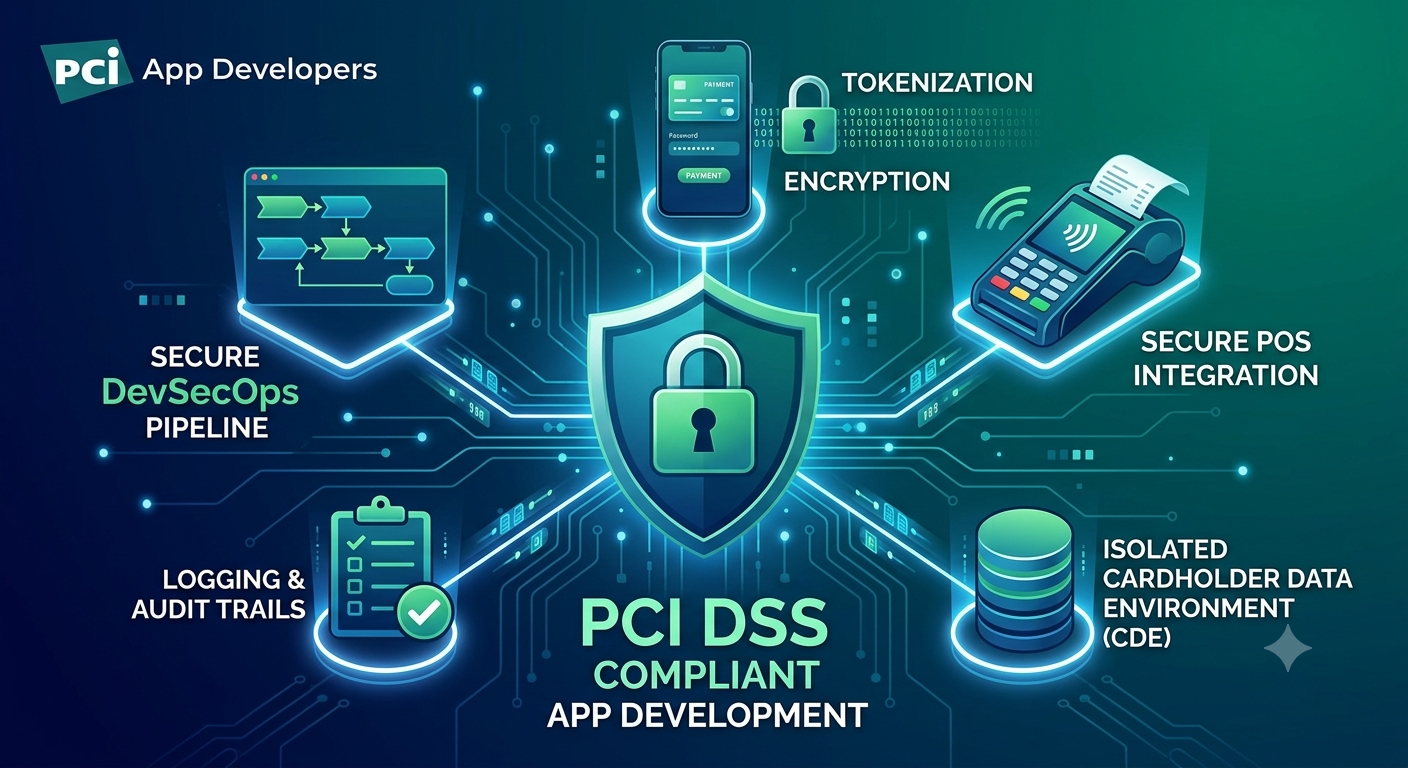
Digital payments are no longer just about completing transactions—they are central to modern customer experience and business operations. In 2026, mobile applications, point-of-sale (POS) systems, e-commerce checkouts, and custom payment gateways handle millions of sensitive cardholder transactions every day.
With this increased transaction volume comes higher risk. Data breaches, API vulnerabilities, and evolving compliance mandates mean businesses cannot treat payment security as an afterthought.
To build payment applications that process card data securely and meet PCI DSS (Payment Card Industry Data Security Standard) 4.0+ requirements, engineering teams must build security directly into the software architecture from day one.
At PCI App Developers (a QuartusTech company), we specialize in crafting PCI-compliant mobile applications, web portals, point-of-sale integrations, and enterprise payment systems designed for real-world reliability and scalability.
What Is PCI-Compliant App Development?
PCI-compliant application development refers to building software that processes, stores, or transmits credit card and payment information in strict accordance with the Payment Card Industry Data Security Standard.
The PCI DSS standards apply to any software application that touches Primary Account Numbers (PAN), cardholder data, or sensitive authentication data (such as PINs and CVVs).
Traditional software development focuses primarily on user experience and business logic:
$$\text{User Action} \longrightarrow \text{App Processing} \longrightarrow \text{Database Storage}$$
PCI-compliant application architecture enforces isolation, tokenization, and encryption at every layer:
$$\text{User Action} \longrightarrow \text{Tokenization / Encryption} \longrightarrow \text{Isolated Cardholder Data Environment (CDE)} \longrightarrow \text{Secure Gateway}$$
Instead of exposing raw cardholder data to your primary database or frontend interfaces, a compliant architecture isolates payment handling to dramatically minimize security risks and audit scope.
Why Payment Security and Scope Reduction Matter in 2026
Achieving and maintaining PCI DSS compliance is essential for businesses processing card transactions. Non-compliance can lead to hefty fines, processing suspension, brand damage, and legal liabilities.
Building a secure, PCI-compliant payment application delivers key operational advantages:
- Scope Reduction: By isolating payment processing using tokenization and hosted fields, developers reduce the systems in the Cardholder Data Environment (CDE), lowering audit complexity and costs.
- End-to-End Encryption (E2EE): Encrypting sensitive data at rest and in transit prevents unauthorized access, even in the event of an infrastructure breach.
- Streamlined Audits: Building with pre-validated security controls makes it simpler to complete annual Self-Assessment Questionnaires (SAQ) or Qualified Security Assessor (QSA) audits.
- Customer Trust: Users expect instantaneous, smooth, and bulletproof payment flows across iOS, Android, and web platforms.
Core Technical Requirements for PCI-Compliant Applications
Developing a secure payment application requires implementing strict technical controls throughout the application stack.
       +--------------------------------------------------------+
       |                  Client Application                    |
       |       (iOS / Android / Web / Smart POS Terminal)        |
       +---------------------------+----------------------------+
                                   |
                     TLS 1.3 / HTTPS Encrypted Channel
                                   |
                                   v
       +--------------------------------------------------------+
       |             Secure API Gateway & Tokenization          |
       +---------------------------+----------------------------+
                                   |
                      Token / Isolated Data Stream
                                   |
                                   v
       +--------------------------------------------------------+
       |           Cardholder Data Environment (CDE)            |
       |    (PCI-Compliant Storage, HSM, Vault & Processor)     |
       +--------------------------------------------------------+
1. Tokenization and Hosted Input Fields
Never handle raw Primary Account Numbers (PAN) directly on your application servers if you can avoid it. Use SDKs and iframe/hosted fields from PCI-certified gateways to swap card details for secure, non-sensitive tokens before the data touches your application logic.
2. Strong Data Encryption (In Transit and At Rest)
- In Transit: All communications between the mobile/web application, backend servers, and payment gateways must enforce TLS 1.3 with strong cipher suites.
- At Rest: If cardholder data must be stored, encrypt it using industry-standard algorithms such as AES-256, leveraging Hardware Security Modules (HSM) or secure key vaults for key management.
3. Secure Key Management
Cryptographic keys should be rotated regularly and stored separately from encrypted payment data. Enforce key-hierarchy principles where master keys encrypt data-encryption keys.
4. Identity, Authentication, and Access Control
Integrate Multi-Factor Authentication (MFA), role-based access controls (RBAC), and OAuth 2.0 with PKCE for user access. Enforce the principle of least privilege so that only authorized microservices or personnel can interact with sensitive payment services.
5. Automated Logging and Audit Trails
Every attempt to access, modify, or process cardholder data must be logged with detailed timestamped audit trails. Ensure logs do not inadvertently capture sensitive payment information, PINs, or CVV codes, and route log streams to write-once-read-many (WORM) storage.
6 Steps to Build a Secure Payment App
Building custom payment applications requires a structured DevSecOps workflow:
- Map Data Flows & Define Scope: Document every point where payment data enters, moves through, or leaves your system. Identify your Cardholder Data Environment (CDE) boundaries.
- Select the Right Architecture: Choose between direct gateway integrations, hosted payment fields, or hardware-bound mobile point-of-sale (mPOS) architectures based on your business model.
- Implement Tokenization & Secure SDKs: Integrate tokenization early to keep raw card data out of your application’s primary databases and server logs.
- Conduct Continuous Penetration Testing: Perform Static Application Security Testing (SAST), Dynamic Application Security Testing (DAST), and independent third-party penetration tests prior to launch.
- Establish DevSecOps & Automated Code Scanning: Integrate dependency scanning (SCA) into your CI/CD pipelines to catch vulnerabilities in open-source libraries before code hits production.
- Prepare Audit Documentation: Maintain thorough technical documentation, data-flow diagrams, and policy frameworks to ensure smooth annual PCI audits.
Custom Payment App Development vs. Off-the-Shelf Tools
While standard payment plugins work for basic e-commerce setups, growing enterprise platforms, multi-merchant marketplaces, and omnichannel restaurant POS ecosystems frequently outgrow generic off-the-shelf software.
Custom PCI payment application development allows organizations to build flexible software adapted to their exact operational workflows:
| Feature / Requirement | Generic Payment Plugins | Custom PCI Application Development |
| Custom Workflows | Fixed checkout templates and flow limits | Custom logic tailored to complex business models |
| Hardware Integration | Basic card readers only | Custom BLE, NFC, mPOS, and smart terminal integrations |
| Multi-Merchant Routing | Limited splitting and routing rules | Advanced payment splitting, multi-acquirer routing, and marketplace payouts |
| Branding & UX | Generic third-party redirect screens | Fully branded, native embedded payment experience |
| System Integrations | Restricted API connectors | Deep native sync with CRM, ERP, Inventory, and POS engines |
How PCI App Developers Helps Build Secure Payment Solutions
At PCI App Developers, we help businesses design, engineer, and deploy secure payment systems built around real operational goals.
Our development expertise spans:
- Mobile Payment Applications: Native iOS and Android payment applications with secure biometric authentication, tokenized checkouts, and encrypted local storage.
- Custom Gateway & POS Integrations: End-to-end payment gateway development, smart terminal app engineering, mPOS software, and restaurant/retail EPOS integration.
- IoT, BLE, and NFC Payment Solutions: Secure proximity-based payment applications combining hardware communication with PCI-compliant server backends.
- PCI Scope Reduction Consulting: Re-engineering existing software architectures to isolate cardholder environments and lower annual compliance costs.
Build Your Next PCI-Compliant Payment App
The future of digital transactions belongs to platforms that combine frictionless user experience with uncompromising data security. Whether you are launching a fintech app, an enterprise payment platform, an omnichannel retail system, or a smart POS solution, establishing a secure software foundation is critical for long-term growth.
Ready to build a secure, PCI-compliant payment application?
Contact the team at PCI App Developers today to discuss your project requirements and transform your vision into a scalable, enterprise-grade payment product.
Comments