Digital payments have become an essential part of modern business. From e-commerce and mobile applications to subscription platforms and financial services, businesses increasingly need payment experiences that are fast, convenient, and secure.
But building a payment application involves much more than connecting a payment gateway.
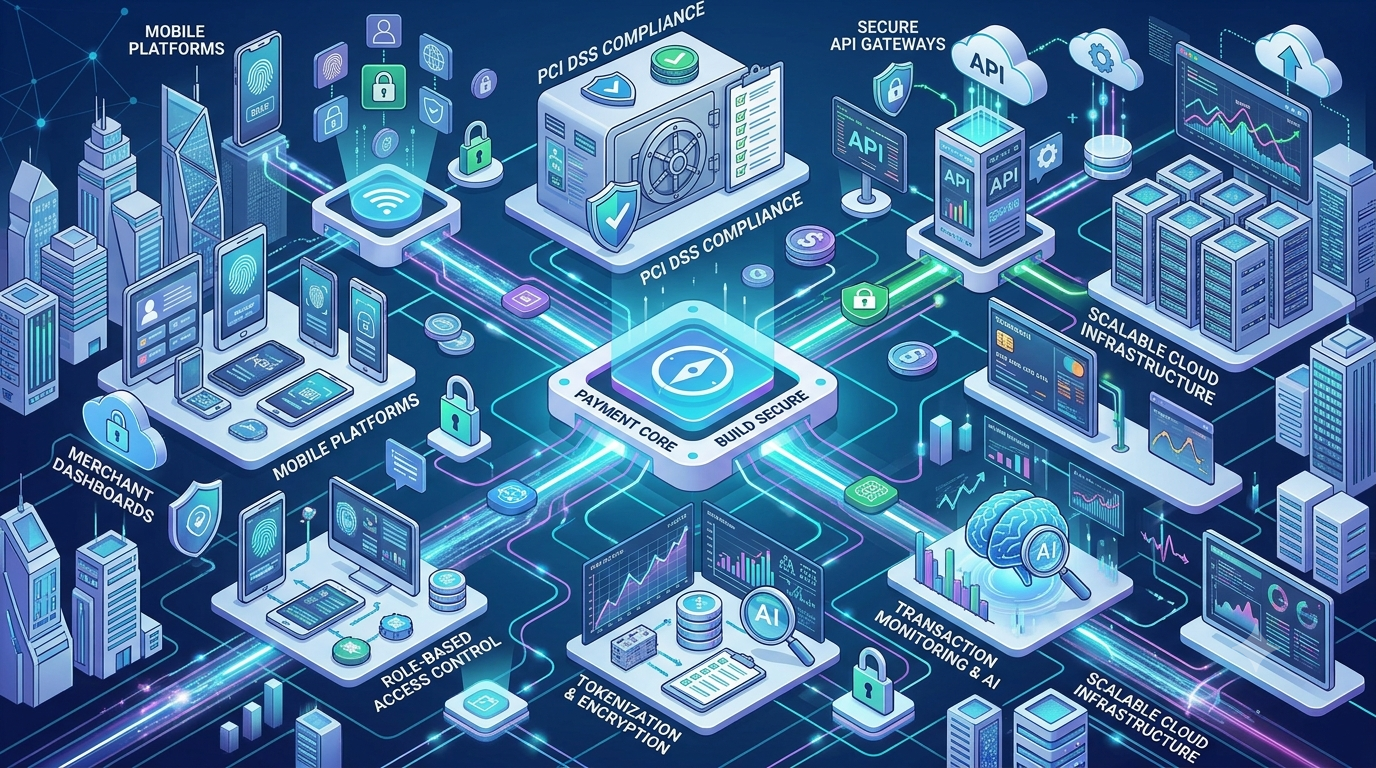
A secure payment app needs thoughtful architecture, strong data protection, secure APIs, authentication, transaction monitoring, and appropriate compliance controls.
For businesses developing payment applications in 2026, security and compliance should be considered from the earliest stages of product development.
What Is a Payment Application?
A payment application enables users or businesses to initiate, process, manage, or monitor electronic payments.
Depending on the business model, a payment application may support:
- Credit and debit card payments
- Digital wallets
- Bank transfers
- Recurring payments
- Subscription billing
- Payment links
- In-app payments
- Refunds
- Transaction management
- Payment reporting
- Merchant dashboards
The architecture required depends on the type of payment application and the data it handles.
Why Payment App Security Matters
Payment applications can interact with highly sensitive information.
A security incident can potentially expose:
- Payment information
- Account credentials
- Transaction details
- Personal information
- Authentication data
- Business information
A secure application therefore needs multiple layers of protection rather than relying on a single security feature.
A typical secure architecture may include:
User → Mobile/Web App → Secure API → Application Server → Payment Gateway → Bank/Payment Network
Each connection needs to be designed and protected appropriately.
1. Start With Security Requirements
Security should be considered before development begins.
The development team should identify:
- What payment data the application handles
- Where data is processed
- Where data is stored
- Which third-party services are involved
- Which users have access
- What authentication methods are required
- Applicable compliance obligations
- Required monitoring and logging
This initial assessment can help prevent expensive architectural changes later.
2. Minimize Sensitive Payment Data
One important approach to payment application security is minimizing the sensitive payment data handled by the application.
Where appropriate, businesses can use payment processors, tokenization, and other technologies to reduce direct exposure to sensitive card information.
For example:
Customer → Secure Payment Interface → Payment Processor
rather than unnecessarily passing sensitive payment information through multiple internal systems.
Reducing the amount of sensitive data within an application can simplify parts of the security and compliance architecture.
3. Use Tokenization
Tokenization replaces sensitive payment information with a token that can be used for authorized payment operations.
For example:
Sensitive Payment Data → Tokenization Service → Payment Token
The application can then work with the token rather than repeatedly handling the original payment information.
The exact implementation depends on the payment architecture and service provider.
Tokenization can be particularly useful for recurring payments and saved payment methods.
4. Secure APIs
Modern payment applications depend heavily on APIs.
APIs may connect:
- Mobile applications
- Web applications
- Payment gateways
- Banking services
- Merchant platforms
- Fraud detection systems
- Customer management systems
Because APIs can provide access to important functions and information, they need appropriate security controls.
These may include:
- Strong authentication
- Authorization
- Input validation
- Rate limiting
- Secure communication
- Access controls
- Monitoring
- Error handling
API security should be incorporated into the application architecture rather than added after development.
5. Protect Data in Transit and at Rest
Payment applications commonly transmit information between multiple systems.
Sensitive data should be protected during transmission using appropriate encryption and secure communication protocols.
Businesses should also consider how sensitive information is stored.
Important questions include:
- What data is stored?
- Why is it stored?
- How long is it retained?
- Who can access it?
- How is it protected?
- When should it be deleted?
A good data strategy focuses not only on encryption but also on minimizing unnecessary data collection and retention.
6. Implement Strong Authentication
Payment applications need to verify that users are who they claim to be.
Depending on the application, authentication can include:
- Password-based authentication
- Multi-factor authentication
- One-time passwords
- Biometrics
- Device-based authentication
- Risk-based authentication
Authentication should be combined with authorization so users can access only the functions and information appropriate to their role.
7. Build Role-Based Access Controls
Not every employee or administrator needs access to every payment function.
For example, a payment platform could have separate roles for:
- Customers
- Merchants
- Support staff
- Finance teams
- Administrators
- Developers
Role-based access controls can restrict sensitive operations based on the user’s responsibilities.
This follows the principle of giving users only the access they need to perform their tasks.
8. Add Transaction Monitoring
Payment security does not end when a transaction is completed.
Applications can incorporate monitoring mechanisms to identify unusual activity.
Depending on the business model, monitoring may consider:
- Transaction frequency
- Transaction amount
- Login activity
- Device information
- Geographic signals
- Failed authentication attempts
- Unusual account behavior
These signals can be used as part of broader fraud detection and risk management systems.
9. Design Secure Payment Workflows
A payment application should account for situations such as:
- Failed transactions
- Duplicate requests
- Network interruptions
- Payment timeouts
- Partial failures
- Refunds
- Chargebacks
- Transaction reversals
For example, an application should avoid accidentally creating two charges because a user taps the payment button twice or a request is retried.
Idempotency and transaction-state management are therefore important considerations when designing payment APIs.
10. Test Security Throughout Development
Security testing should not happen only immediately before launch.
A secure development lifecycle can include:
Planning → Design → Development → Code Review → Security Testing → Deployment → Monitoring
Testing may include:
- Vulnerability scanning
- API security testing
- Authentication testing
- Authorization testing
- Dependency analysis
- Penetration testing
- Configuration reviews
The exact testing approach depends on the application and its risk profile.
PCI DSS and Payment Application Development
Businesses that store, process, or transmit payment card data may have obligations under the Payment Card Industry Data Security Standard (PCI DSS), depending on their payment environment and responsibilities.
PCI DSS provides a framework of technical and operational requirements designed to help protect payment account data.
Compliance should not be treated as simply adding a certification badge to an application.
Instead, businesses should consider security and compliance throughout:
- Application architecture
- Infrastructure
- Access management
- Data handling
- Development practices
- Monitoring
- Testing
- Documentation
The exact compliance responsibilities can vary depending on how a business’s payment environment is structured.
Payment Gateway Integration
Many businesses choose to integrate established payment gateways instead of building payment processing infrastructure from scratch.
A payment gateway integration may support:
- Payment authorization
- Transaction processing
- Refunds
- Recurring payments
- Payment status updates
- Webhooks
- Transaction reporting
When integrating a payment provider, developers should carefully review its API documentation, security requirements, webhook handling, authentication mechanisms, and compliance responsibilities.
Build for Scalability
Payment applications may experience significant changes in transaction volume.
A small application could eventually support:
- More customers
- More merchants
- More transactions
- Multiple payment methods
- Multiple currencies
- Multiple regions
- Additional integrations
Scalable architecture can help businesses expand without rebuilding the entire payment platform.
Cloud infrastructure, modular services, caching, database optimization, monitoring, and reliable APIs can all play a role in scalability.
Mobile Payment Apps Need Additional Considerations
Mobile payment applications introduce additional security considerations because smartphones are personal and constantly connected devices.
Developers should consider:
- Secure local storage
- Session management
- Device authentication
- API security
- App integrity
- Secure communication
- Biometric authentication
- Protection against reverse engineering
- Secure update mechanisms
The application should avoid unnecessarily storing sensitive payment information on the user’s device.
Why Custom Payment App Development Can Help
Different businesses have different payment workflows.
A fintech platform may require a complex transaction architecture.
An e-commerce company may need subscription billing.
A SaaS company may need recurring payments.
A marketplace may need payment flows between multiple parties.
A custom payment application can be designed around the business’s specific requirements, integrations, user roles, and operational workflows.
How PCIAppDeveloper Can Help
PCIAppDeveloper focuses on payment application development with an emphasis on secure architecture, payment integrations, and PCI-aware development practices.
Depending on project requirements, payment application development can include:
- Payment gateway integration
- Secure payment applications
- Mobile payment apps
- Payment APIs
- Digital wallet solutions
- Recurring payment systems
- Merchant dashboards
- Transaction management
- Payment security
- PCI-focused development
- Third-party payment integrations
The development approach should be based on the business model, payment flow, data environment, and applicable compliance requirements.
Final Thoughts
Building a payment application in 2026 requires more than creating a convenient checkout experience.
Businesses need to think about:
Security + Compliance + Architecture + APIs + Data Protection + Scalability
from the beginning.
By minimizing sensitive data exposure, using secure payment integrations, implementing strong access controls, protecting APIs, monitoring transactions, and incorporating security throughout development, businesses can build payment applications designed for modern digital commerce.
For organizations planning a new payment platform or upgrading an existing payment application, a security-focused development strategy can provide a stronger foundation for future growth.
SEO Keywords
- payment app development
- payment application development
- PCI compliant app development
- PCI DSS compliant payment app
- payment gateway integration
- secure payment app development
- payment software development
- payment app developers
- fintech app development
- mobile payment app development
- payment API development
- PCI DSS compliance
- secure payment solutions
- custom payment software
Meta Title
Secure Payment App Development in 2026 | PCIAppDeveloper
Meta Description
Learn how to build a secure payment application with PCI-focused architecture, tokenization, API security, authentication, payment gateway integration, and scalable infrastructure.
Suggested URL Slug
/blogs/secure-payment-app-development-2026/
Comments