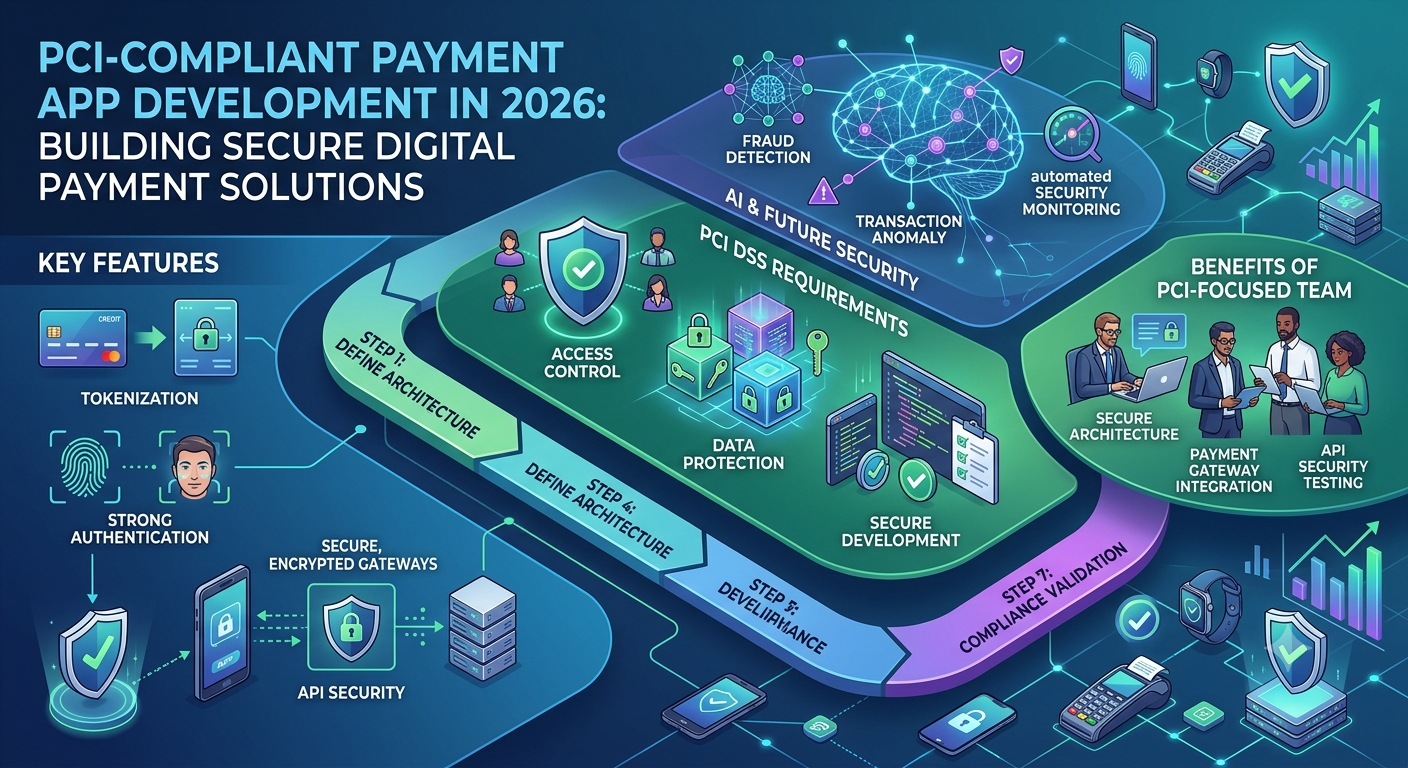
Digital payments are now a core part of modern business. From mobile wallets and payment gateways to fintech platforms and subscription applications, businesses need payment systems that are not only convenient but also secure.
This is where PCI-compliant payment app development becomes essential.
A payment application handles sensitive information such as cardholder data, transaction details, authentication information, and payment credentials. A security failure can result in financial losses, data breaches, customer distrust, and regulatory challenges.
In 2026, businesses developing payment applications need to consider PCI DSS compliance, secure payment architecture, encryption, tokenization, API security, authentication, and continuous monitoring from the beginning of the development process.
What Is PCI-Compliant Payment App Development?
PCI-compliant payment app development is the process of designing, developing, testing, and maintaining a payment application according to applicable requirements of the Payment Card Industry Data Security Standard (PCI DSS).
The objective is to protect cardholder data throughout its lifecycle and reduce security risks associated with payment processing.
A PCI-focused payment application may include:
- Mobile payment applications
- Payment gateway integrations
- Digital wallet applications
- Online payment platforms
- Subscription billing systems
- Fintech applications
- Merchant payment solutions
- POS payment applications
- Card-not-present payment systems
Compliance should not be treated as a final development checklist. Security needs to be incorporated into the application’s architecture and development lifecycle.
Why PCI Compliance Matters for Payment Apps
Payment applications are attractive targets for cyberattacks because they process valuable financial information.
A secure payment application can help businesses address risks such as:
- Unauthorized access
- Payment data theft
- API vulnerabilities
- Credential attacks
- Malware and malicious code
- Data interception
- Improper access controls
- Insecure third-party integrations
PCI DSS provides a structured security framework that organizations can use when protecting payment-card environments.
However, PCI DSS compliance depends on the specific payment environment, technologies, responsibilities, and applicable requirements. Businesses should therefore determine their exact compliance obligations rather than assuming that every payment application has the same scope.
Key Features of a Secure Payment Application
1. Secure Payment Processing
Payment transactions should be processed through properly secured payment infrastructure and trusted payment service providers.
The application architecture should minimize unnecessary exposure of sensitive payment information.
2. Encryption
Encryption helps protect sensitive information when data is transmitted or stored.
A payment application should use appropriate cryptographic controls and secure communication protocols based on the application’s architecture and compliance requirements.
3. Tokenization
Tokenization can reduce the need for applications to directly handle sensitive card data.
Instead of repeatedly storing or transmitting actual card information, a token can represent the payment credential within supported payment architectures.
This can help reduce the application’s exposure to sensitive payment data.
4. Strong Authentication
Authentication is an important layer of payment application security.
Depending on the use case, developers may implement:
- Multi-factor authentication
- Secure password policies
- Biometric authentication
- Session management
- Risk-based authentication
- Role-based access controls
5. API Security
Modern payment applications frequently depend on APIs for communication between mobile apps, web applications, payment processors, banking services, and backend systems.
Secure API development should consider:
- Authentication
- Authorization
- Input validation
- Rate limiting
- Secure error handling
- API monitoring
- Encryption
- Protection against common API attacks
6. Secure Logging and Monitoring
Payment systems need visibility into important security events.
Logging and monitoring can help identify suspicious activity, failed authentication attempts, unusual transactions, configuration changes, and other security events.
Logs themselves should also be protected and managed appropriately.
PCI DSS and Payment App Development
PCI DSS requirements can affect multiple areas of a payment application’s technology environment.
Developers and organizations may need to consider areas such as:
Access Control: Only authorized users and systems should have access to relevant resources.
Data Protection: Sensitive payment information needs appropriate protection throughout its lifecycle.
Vulnerability Management: Systems should be regularly assessed and maintained against known security vulnerabilities.
Secure Development: Applications should be developed using secure software-development practices.
Monitoring: Security events and relevant system activity should be monitored.
Testing: Security controls should be tested regularly based on applicable requirements and scope.
The exact requirements depend on the organization’s environment and role in payment processing.
PCI-Compliant Payment App Development Process
A structured development process can help businesses build security into the product from the beginning.
Step 1: Define the Payment Architecture
Start by understanding how payments will move through the system.
Identify:
- Users
- Mobile and web applications
- Backend services
- Payment gateways
- Third-party APIs
- Databases
- Authentication systems
- Cardholder-data flows
This helps establish the potential PCI scope and security boundaries.
Step 2: Perform Security and Compliance Planning
Before development begins, identify applicable PCI DSS requirements and determine which responsibilities belong to the application owner, development team, payment processor, hosting provider, and other service providers.
Step 3: Design a Secure Architecture
Security should be considered at the architecture stage.
Common considerations include:
- Network segmentation
- Secure APIs
- Encryption
- Tokenization
- Least-privilege access
- Secure authentication
- Secrets management
- Secure cloud configuration
Step 4: Develop the Application Securely
Developers should follow secure coding practices and continuously review the application for vulnerabilities.
Code reviews, dependency management, secure configuration, and security testing should be integrated into the development lifecycle.
Step 5: Integrate Payment Services
Payment gateways and third-party services should be integrated carefully.
Businesses should understand what payment information is handled by their application and what is handled by the external payment provider.
Step 6: Conduct Security Testing
Testing may include:
- Vulnerability assessments
- Penetration testing
- API security testing
- Authentication testing
- Code review
- Dependency scanning
- Configuration reviews
Testing requirements depend on the applicable PCI DSS scope and environment.
Step 7: Compliance Validation
After implementation, organizations should validate their compliance according to the applicable PCI DSS requirements and their specific validation obligations.
Compliance is an ongoing process rather than a one-time development milestone.
Common Mistakes in Payment App Development
Businesses sometimes focus heavily on functionality while treating security as a later-stage requirement.
Common mistakes include:
Storing Unnecessary Card Data
Applications should avoid storing sensitive payment information unless there is a legitimate business and technical requirement and the environment is designed to protect it appropriately.
Ignoring API Security
A secure-looking mobile interface does not guarantee secure backend APIs.
Attackers can target APIs directly, making backend security critical.
Using Outdated Dependencies
Old frameworks, libraries, and third-party components can introduce known vulnerabilities.
Dependency management should therefore be part of the software development lifecycle.
Treating Compliance as a Checkbox
Passing an assessment does not mean security can be ignored afterward.
Applications change continuously, and security controls need ongoing management.
Poor Access Management
Developers, administrators, and service accounts should receive only the access necessary for their roles.
How AI Is Changing Payment Security in 2026
Artificial intelligence is increasingly being used across cybersecurity and financial technology.
Payment platforms can use AI and machine learning techniques for areas such as:
- Fraud detection
- Transaction anomaly detection
- Behavioral analysis
- Risk scoring
- Automated security monitoring
- Threat detection
However, AI does not replace fundamental security controls or PCI DSS requirements.
Businesses should view AI as an additional security capability rather than a substitute for secure architecture, access controls, encryption, vulnerability management, and compliance processes.
Benefits of Working With a PCI-Focused Development Team
Developing a payment application requires more than standard mobile or web development.
A specialized team can help businesses address:
- Secure payment architecture
- Payment gateway integration
- API security
- Data protection
- Tokenization strategies
- Authentication
- Security testing
- Compliance-focused development
- Ongoing application maintenance
The development team should also work with the organization’s compliance and security professionals where formal PCI validation is required.
Choosing a PCI-Compliant Payment App Development Partner
Before selecting a development partner, businesses should evaluate their experience in:
- Payment application development
- PCI DSS requirements
- Fintech software
- Payment gateway integration
- Mobile and web application security
- API development
- Cloud security
- Secure software development
- Security testing
It is also important to clarify who is responsible for compliance activities. A software development company can build an application using security and compliance-oriented practices, but PCI DSS compliance is ultimately dependent on the complete payment environment and applicable responsibilities, not simply the development company.
Conclusion
Secure payment applications require security to be built into the product from architecture through deployment and maintenance.
PCI-compliant payment app development combines secure software engineering, payment integration, data protection, access management, vulnerability management, monitoring, and appropriate compliance validation.
For businesses building a payment gateway, fintech platform, digital wallet, POS application, or mobile payment solution in 2026, taking a security-first approach can help create a more resilient payment environment while supporting customer trust.
If your business is planning a secure payment application, start by mapping the payment-data flow, defining PCI scope, selecting the appropriate payment architecture, and integrating security into every stage of development.
Comments