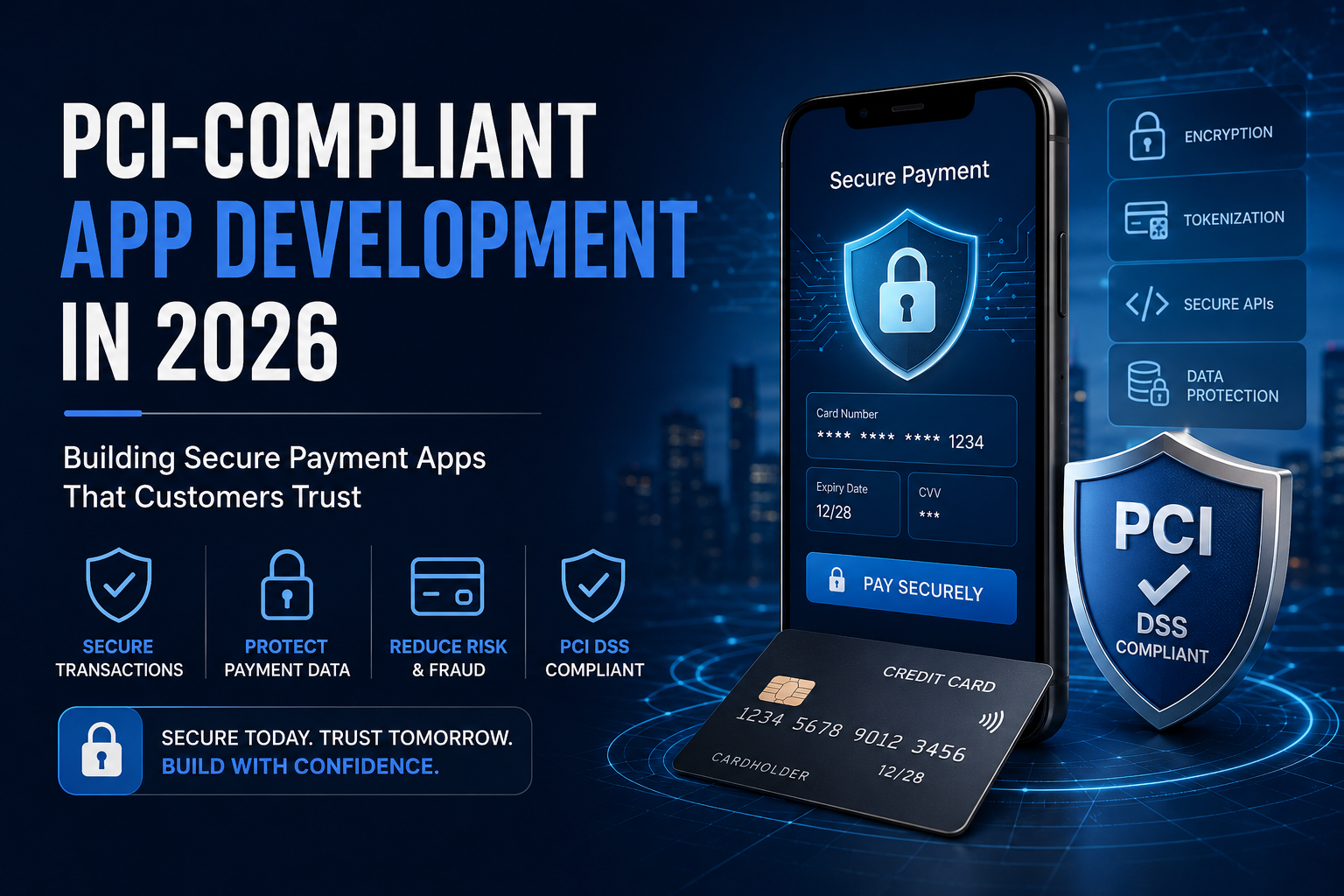
In today’s digital economy, customers expect payments to be fast, convenient, and secure. Businesses, meanwhile, need more than a smooth checkout experience—they need confidence that sensitive payment information is protected at every stage.
This is where PCI-compliant app development becomes essential.
Whether you’re building a mobile wallet, eCommerce application, POS solution, subscription platform, or fintech product, security cannot be treated as an afterthought. A well-designed payment application should incorporate security and compliance from the earliest stages of development.
What Is PCI-Compliant App Development?
PCI-compliant app development refers to designing and developing applications that follow the security requirements established by the Payment Card Industry Data Security Standard (PCI DSS) when the application handles payment card data.
PCI DSS focuses on protecting cardholder data and reducing the risk of unauthorized access, fraud, and data breaches.
For app developers and businesses, this means thinking about security across the entire application ecosystem—from the user interface and APIs to databases, payment gateways, servers, and third-party integrations.
Why PCI Compliance Matters for Mobile and Web Apps
A payment application can process thousands or even millions of transactions. A single security weakness can expose sensitive information and damage customer trust.
PCI-focused development helps businesses:
- Protect sensitive payment information
- Reduce security vulnerabilities
- Minimize the risk of data breaches
- Build customer confidence
- Strengthen payment infrastructure
- Support safer digital transactions
- Meet applicable payment security obligations
Security is especially important for businesses developing applications that connect with payment gateways, POS systems, digital wallets, recurring billing platforms, or financial services.
Key Elements of a Secure PCI-Compliant Payment App
1. Secure Payment Architecture
The architecture should be designed to minimize unnecessary exposure of cardholder data.
Whenever possible, businesses can use established payment gateways and tokenization solutions instead of storing raw card information inside their own application infrastructure.
A secure architecture should clearly define:
- Where payment information enters the system
- How it is transmitted
- Where sensitive information is processed
- Which systems can access it
- What information is stored
- How access is monitored
2. Encryption
Sensitive information should be protected during transmission and, where applicable, while stored.
Strong encryption practices help prevent attackers from easily using intercepted or exposed data.
Developers should also avoid hard-coding sensitive credentials, API keys, passwords, or other secrets into mobile applications or source code.
3. Tokenization
Tokenization can significantly reduce the amount of sensitive card data handled by an application.
Instead of repeatedly processing actual card details, a payment provider can generate a token that represents the payment information.
This approach can help reduce the application’s exposure to sensitive cardholder data and simplify parts of the security architecture.
4. Strong Authentication and Authorization
A secure payment app should ensure that users and administrators can access only the resources they are authorized to use.
Depending on the application, security mechanisms may include:
- Multi-factor authentication
- Secure session management
- Role-based access control
- Strong password policies
- Device and account verification
- API authentication
Administrative dashboards deserve particular attention because compromised administrative credentials can provide attackers with extensive access.
API Security Is Critical
Modern payment applications rarely operate as standalone systems.
They communicate with:
- Payment gateways
- Banking platforms
- POS systems
- Cloud services
- Customer databases
- Authentication platforms
- Analytics systems
- Third-party APIs
Every integration can introduce another potential attack surface.
Developers should therefore implement secure API authentication, authorization, input validation, rate limiting, logging, and appropriate monitoring.
APIs should expose only the information and functionality that a specific application actually needs.
Secure Mobile App Development
Mobile payment applications require additional considerations because applications run on devices that developers do not completely control.
Developers should consider:
- Secure local storage
- Certificate validation
- Application integrity
- Secure authentication
- Session expiration
- Protection against reverse engineering
- Secure API communication
- Minimal storage of sensitive information
Sensitive payment information should not simply be stored locally because it is convenient for the development team.
The guiding principle should be simple:
If the application does not need to store sensitive information, don’t store it.
Secure Development Should Start Before Coding
One of the biggest mistakes businesses make is treating compliance as a final-stage checklist.
By the time an application is ready for launch, changing the underlying architecture can be expensive and time-consuming.
A better approach is to include security throughout the development lifecycle.
A practical development process
Step 1: Define the payment flow
Understand exactly how transactions move through the application.
Step 2: Identify sensitive data
Determine what payment and customer information is collected, transmitted, processed, or stored.
Step 3: Reduce the data environment
Avoid unnecessary collection and storage of sensitive payment information.
Step 4: Design secure APIs
Implement authentication, authorization, validation, logging, and monitoring.
Step 5: Integrate trusted payment services
Use established payment infrastructure where appropriate instead of unnecessarily building sensitive payment-processing functionality from scratch.
Step 6: Test security continuously
Perform code reviews, vulnerability assessments, penetration testing, dependency checks, and security testing throughout development.
Step 7: Maintain compliance after launch
Security is an ongoing process. Applications, dependencies, infrastructure, APIs, and threats continuously change.
Common PCI Security Mistakes Developers Should Avoid
Even well-designed applications can create unnecessary security risks through simple development mistakes.
Common problems include:
Storing unnecessary cardholder data
Keeping sensitive information “just in case” increases the potential impact of a breach.
Exposing secrets in source code
API keys, credentials, and tokens should never be casually embedded in public repositories or application binaries.
Ignoring third-party dependencies
Outdated libraries and vulnerable packages can create security weaknesses.
Poor access control
Users and internal employees should receive only the permissions they actually need.
Insecure APIs
An application may have a secure interface but still expose sensitive information through poorly protected backend APIs.
Treating compliance as a one-time activity
Passing an assessment does not mean security can be ignored afterward.
PCI Compliance and Cloud Applications
Many modern payment applications run on cloud infrastructure.
Cloud platforms can provide powerful security capabilities, but simply deploying an application to the cloud does not automatically make the application PCI compliant.
Businesses still need to understand:
- Their compliance responsibilities
- Data flows
- Access controls
- Network configuration
- Logging and monitoring
- Encryption
- Application security
- Third-party services
A secure cloud architecture requires clearly defined responsibilities between the business, development team, and cloud/service providers.
Why Businesses Should Choose PCI-Focused App Developers
Payment applications require a different mindset from ordinary mobile or web applications.
The objective isn’t simply:
“Build an app that works.”
It is:
“Build an app that works securely, reliably, and responsibly with payment data.”
A development partner experienced in PCI-focused application development can help businesses address security considerations from architecture through deployment and maintenance.
This can be especially valuable for:
- Fintech startups
- Payment platforms
- eCommerce businesses
- Restaurant technology companies
- Retail businesses
- SaaS companies
- Digital wallet providers
- POS software companies
- Subscription businesses
The Future of PCI-Compliant App Development
Payment technology is evolving rapidly.
Mobile wallets, contactless payments, biometric authentication, AI-powered fraud detection, embedded finance, cloud-native applications, and connected POS systems are changing how businesses handle transactions.
As payment ecosystems become more connected, security needs to become more integrated into application development—not added after the product is built.
The future belongs to applications that combine great user experience with strong security architecture.
Final Thoughts
PCI compliance isn’t simply a technical requirement. It is part of building customer trust.
A payment application should be designed with security from the first architecture discussion through development, testing, deployment, and ongoing maintenance.
For businesses planning a new payment application in 2026, the right question isn’t just:
“How quickly can we launch?”
It should also be:
“How securely can we build it?”
Because when customers trust an application with their payments, security becomes part of the product itself.
Looking to Build a Secure Payment Application?
A PCI-focused development strategy can help businesses create secure mobile, web, POS, and payment applications while reducing unnecessary exposure to sensitive payment information.
If you’re planning a PCI-compliant payment app, fintech platform, mobile wallet, POS application, or secure payment solution, start with security at the architecture level—not after development is complete.
Comments