It’s Friday, and while everyone is thinking about weekend plans, payment apps are still working 24/7.
A customer taps a card.
A mobile wallet processes a payment.
A payment gateway verifies a transaction.
A fraud engine checks suspicious activity.
And somewhere in the background, a security system is basically saying:
“Please don’t let anyone mess this up.” 😄
For businesses building payment applications, security isn’t a feature that can be added later. It needs to be part of the product architecture from day one.
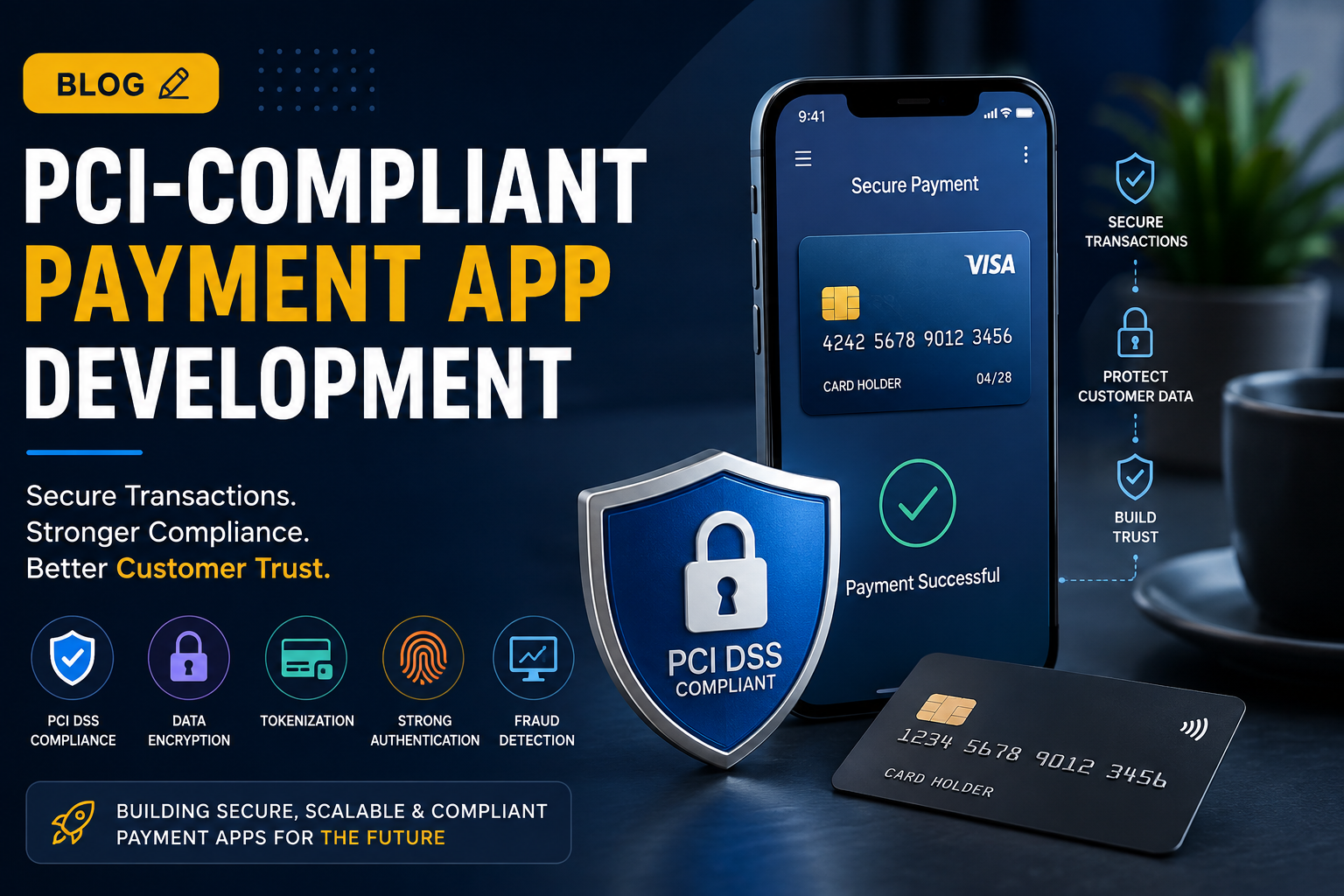
This is where PCI-compliant payment app development becomes critical.
What Is PCI Compliance?
PCI DSS, or the Payment Card Industry Data Security Standard, provides security requirements designed to protect payment card data.
For businesses handling payment card information, compliance involves implementing appropriate security controls around areas such as:
- Cardholder data protection
- Access control
- Network security
- Secure software development
- Vulnerability management
- Monitoring and logging
- Security testing
- Incident response
The exact compliance responsibilities depend on how a business stores, processes, or transmits payment card data.
The important point is simple:
Payment software needs security built into its architecture—not painted on afterward.
Why Payment App Security Matters More Than Ever
Digital payments are becoming increasingly sophisticated.
Modern payment ecosystems can involve:
Mobile App → Payment Gateway → API → Processor → Bank → Customer
There may also be:
- Digital wallets
- Tokenization
- Authentication services
- Fraud detection
- Cloud infrastructure
- Analytics platforms
- Customer databases
Every additional integration creates another area that needs to be secured and monitored.
A payment application therefore needs to protect not only the transaction itself but the entire ecosystem surrounding it.
1. Don’t Store Sensitive Card Data Unless You Really Need To
One of the most important architectural decisions is determining what payment information the application actually needs to handle.
Businesses should minimize sensitive data wherever possible.
Instead of unnecessarily storing payment card information, payment applications can use approaches such as tokenization, where a token represents payment information without exposing the underlying card data to every component of the system.
This can reduce the amount of sensitive payment information that an application directly handles.
2. Tokenization Can Reduce Payment Data Exposure
Imagine a customer saves a card in a payment application.
A poorly designed system might attempt to store sensitive card information directly.
A better architecture can use a payment provider to securely handle the card details and return a token.
The workflow can look like:
Card Details → Secure Payment Provider → Token → Application
The application can then use the token for future transactions without unnecessarily handling the original card information.
This is one reason payment architecture should be carefully planned before development begins.
3. Encryption Is Essential
Payment applications transmit sensitive information across multiple systems.
Encryption helps protect information while it is being transmitted and stored.
Security considerations can include:
- Encryption in transit
- Encryption at rest
- Secure key management
- Certificate management
- Secure API communication
- Protected credentials
A secure payment application should assume that sensitive information needs protection throughout its lifecycle.
4. APIs Need Serious Security
Modern payment applications depend heavily on APIs.
A typical payment workflow might involve:
Mobile App → API → Payment Service → Transaction Response
If API security is weak, attackers may attempt to exploit authentication, authorization, validation, or business-logic weaknesses.
Payment APIs should therefore be designed with appropriate controls such as:
- Strong authentication
- Authorization
- Input validation
- Rate limiting
- Secure session management
- Logging
- Monitoring
- Error handling
A payment API should never assume that requests coming from an application are automatically trustworthy.
5. Authentication Is More Than a Password
Passwords alone may not provide sufficient protection for sensitive payment environments.
Depending on the application and risk profile, businesses can consider:
- Multi-factor authentication
- Biometric authentication
- Device verification
- Risk-based authentication
- Session controls
- Secure password policies
The objective is to make it significantly harder for unauthorized users to access accounts or perform fraudulent transactions.
6. Fraud Detection Is Becoming Smarter
Security isn’t only about protecting infrastructure.
Businesses also need to identify suspicious transactions.
Modern payment systems can use analytics and AI-based approaches to identify unusual behavior.
For example:
Normal Transaction Pattern
↓
Sudden Unusual Location
↓
Unusual Transaction Amount
↓
Multiple Rapid Transactions
↓
Risk Score Increases
↓
Additional Verification
AI and machine learning can help payment platforms analyze patterns and identify potentially suspicious activity.
However, automated fraud detection should be carefully designed to minimize both fraud and unnecessary transaction declines.
7. Mobile Payment Apps Need Device-Level Security
Payment applications running on smartphones face unique security considerations.
Developers need to think about:
- Secure local storage
- Session management
- Device authentication
- Application integrity
- Secure API communication
- Jailbreak/root detection where appropriate
- Protection against reverse engineering
- Secure handling of sensitive information
A payment application should avoid unnecessarily exposing sensitive information through logs, local storage, debugging interfaces, or insecure application behavior.
8. Cloud Security Matters Too
Many modern payment applications use cloud infrastructure.
That introduces additional considerations around:
- Identity and access management
- Database security
- Network configuration
- Encryption
- Secrets management
- Monitoring
- Backups
- Vulnerability management
A payment application may have excellent mobile security but still be vulnerable if the backend infrastructure is poorly configured.
Security is an ecosystem.
9. Secure Software Development Should Start Early
One of the biggest mistakes businesses can make is waiting until the end of development to think about security.
Security should be considered during:
Planning → Architecture → Development → Testing → Deployment → Monitoring
Development teams can incorporate:
- Secure coding practices
- Code reviews
- Dependency management
- Vulnerability scanning
- Penetration testing
- Security testing
- Secure CI/CD processes
Fixing a security problem during architecture is usually much easier than discovering it after launch.
10. Payment Apps Need Continuous Monitoring
Launching a secure application doesn’t mean security work is finished.
Payment applications should be monitored continuously for:
- Suspicious activity
- Failed authentication attempts
- API abuse
- Unusual transactions
- Infrastructure anomalies
- Vulnerability alerts
- Unexpected application behavior
Logs and monitoring can help security teams identify potential incidents and investigate them more quickly.
PCI Compliance Is Not Just a Checkbox
One common misconception is that PCI compliance is simply a certification exercise.
In reality, payment security involves ongoing processes.
Businesses need to understand:
- What payment data they handle
- Where it flows
- Which systems process it
- Which third parties are involved
- What security controls are required
- How those controls are maintained
- What validation requirements apply to their specific environment
The compliance path depends on the business model, architecture, payment flows, and applicable PCI requirements.
That’s why businesses should determine their compliance responsibilities early in the product-development process.
A Secure Payment App Architecture
A modern payment application might be structured around:
Mobile Application
↓
Secure API Layer
↓
Authentication & Authorization
↓
Payment Gateway / Processor
↓
Tokenization
↓
Backend Services
↓
Secure Database
↓
Monitoring & Analytics
This architecture can be further expanded with fraud detection, notifications, customer management, reporting, and administrative systems.
The exact architecture should depend on the business requirements and payment-processing model.
Common Payment App Development Mistakes
Storing Unnecessary Card Data
If sensitive data doesn’t need to be stored, don’t create unnecessary exposure.
Ignoring Third-Party Integrations
Payment applications often depend on external services. Every integration needs security consideration.
Weak Authentication
Sensitive financial applications require strong access controls.
Poor API Security
An insecure backend can compromise an otherwise well-designed mobile application.
No Security Testing
Security should be tested before launch and continuously afterward.
Treating Compliance as a Final Step
Compliance requirements should influence architecture and development from the beginning.
What Businesses Should Consider Before Building a Payment App
Before starting a payment application project, businesses should answer:
What type of payments will the application support?
Card payments, wallets, recurring payments, transfers, or other payment flows may require different architectures.
Who handles the card data?
Determine which systems and third parties will process sensitive payment information.
What information actually needs to be stored?
Minimize sensitive data wherever possible.
Which payment providers will be integrated?
Provider capabilities, APIs, security requirements, and geographic availability should be evaluated.
What compliance requirements apply?
Determine the relevant PCI DSS responsibilities and validation requirements for the specific business model.
How will fraud be detected?
Define risk controls before the system is deployed.
How will the system scale?
Payment platforms may need to support significant transaction volumes and multiple markets.
The Future of Payment Applications
Payment technology is becoming increasingly intelligent.
The next generation of payment applications will combine:
Secure Payments + Tokenization + AI + Mobile + Cloud + Fraud Detection + Automation
AI can help analyze transaction patterns.
Cloud infrastructure can provide scalability.
Mobile applications can deliver convenient payment experiences.
Tokenization can help reduce exposure to sensitive card information.
Automation can simplify payment operations.
But security remains the foundation connecting all of these technologies.
Building a PCI-Focused Payment Application
Businesses developing payment applications need more than a good user interface.
They need an architecture designed around:
- Security
- Compliance
- Scalability
- Reliability
- API integration
- Payment processing
- Fraud prevention
- Data protection
- Monitoring
A specialized payment application development approach can help businesses design these requirements into the product from the beginning rather than attempting to retrofit security later.
Final Thoughts
A payment application may look simple from the customer’s perspective.
Tap. Pay. Done.
Behind that simple experience, however, can be a complex ecosystem involving mobile applications, APIs, payment processors, authentication, tokenization, cloud infrastructure, fraud detection, databases, and security controls.
That’s why PCI-compliant payment app development requires careful planning.
The best payment experience is one where customers don’t have to think about security because the technology is doing its job quietly in the background.
And unlike a Friday production deployment…
payment security is one thing you definitely don’t want to “fix on Monday.” 😄
SEO Title
PCI-Compliant Payment App Development in 2026: Security & Best Practices
Meta Description
Learn how to build secure, scalable PCI-compliant payment apps using tokenization, encryption, API security, fraud detection, cloud security, and secure development practices.
Primary Keywords
PCI-compliant payment app development, payment app development, PCI DSS compliance
Secondary Keywords
PCI compliant app development, secure payment app development, payment application development, payment gateway integration, payment app security, PCI DSS payment applications, tokenized payments, mobile payment app development, secure payment software, fintech app development
Comments