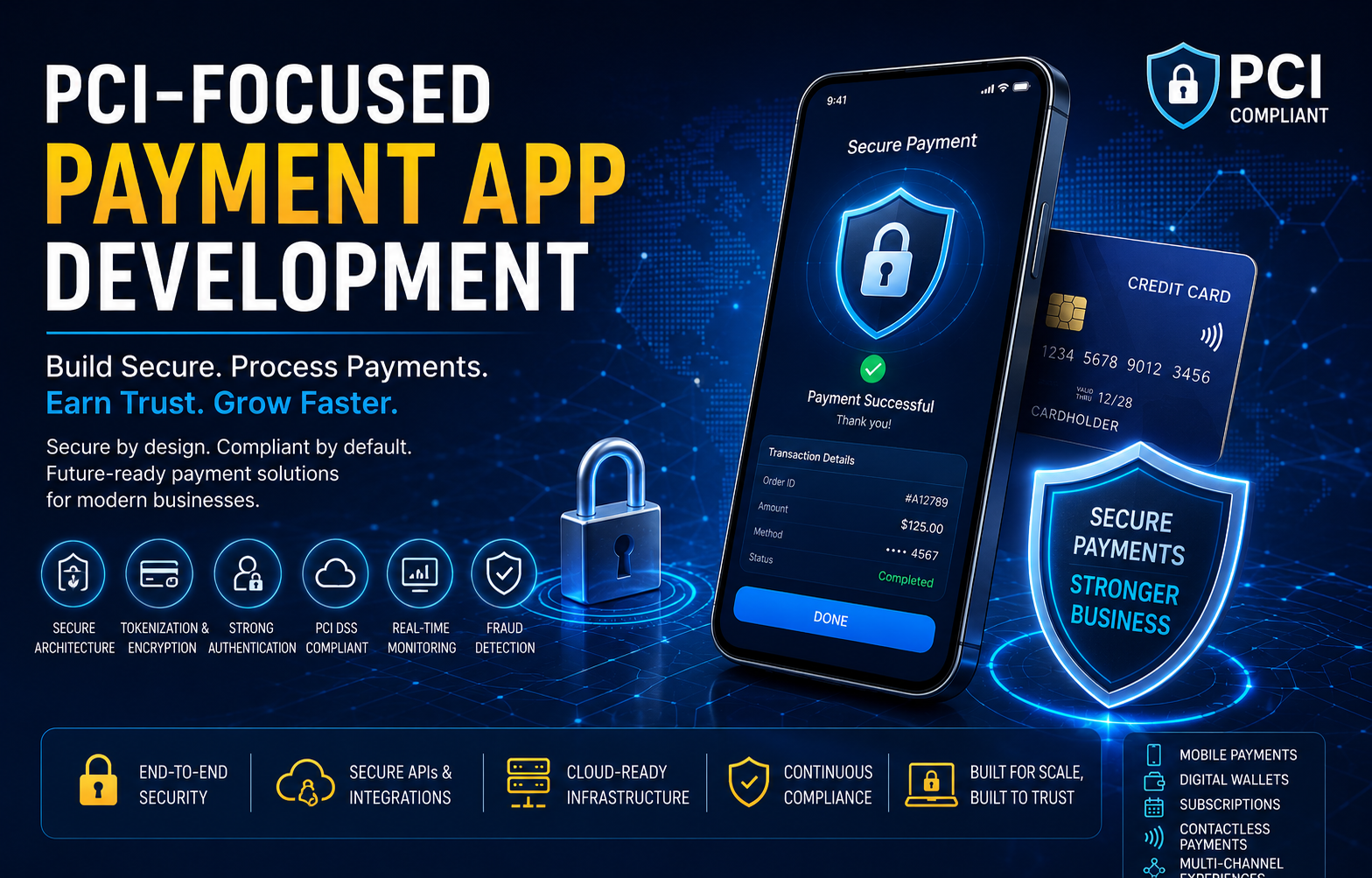
Payment applications have changed dramatically. Customers now expect fast checkout, mobile payments, digital wallets, subscription billing, contactless experiences, and seamless transactions across multiple devices.
But behind every convenient payment experience is a much bigger challenge:
How do you build payment software that remains secure as the product, users, integrations, and attack surface grow?
For modern payment applications, security cannot be something added immediately before launch. It needs to be part of the architecture, development process, testing strategy, and maintenance lifecycle from day one.
This is where PCI-focused payment app development becomes different from ordinary application development.
The Payment App Is No Longer Just a Checkout Screen
A modern payment application can involve an entire ecosystem:
Mobile App → Payment SDK → API → Payment Gateway → Tokenization → Backend → Database → Analytics
There may also be integrations with:
- Digital wallets
- POS systems
- Subscription platforms
- Fraud detection services
- CRM platforms
- Banking APIs
- Cloud infrastructure
- Third-party payment processors
Every additional integration can introduce another security consideration.
That means developers need to think about the complete payment flow, rather than focusing only on the checkout interface.
PCI Compliance Starts With Architecture
One of the biggest mistakes businesses make is asking:
“How do we make our application PCI compliant?”
after the application has already been built.
A better question is:
“How should we architect the application so that payment security is built into the product from the beginning?”
PCI DSS provides baseline technical and operational requirements for environments that store, process, or transmit payment account data.
For developers, this means security decisions need to happen during:
Planning → Architecture → Development → Testing → Deployment → Maintenance
The PCI Secure Software Lifecycle standard similarly emphasizes integrating security throughout the software lifecycle rather than treating security as a final-stage activity.
The Most Important Decision: Reduce Payment Data Exposure
One of the smartest approaches to payment application architecture is to minimize how much sensitive payment information your own systems actually handle.
Instead of unnecessarily allowing sensitive card data to travel through multiple application components, businesses can evaluate architectures involving:
- Hosted payment pages
- Secure payment fields
- Tokenization
- Payment processor integrations
- End-to-end encryption
- Carefully scoped APIs
The goal is simple:
Collect less sensitive data. Store less sensitive data. Expose less sensitive data.
Reducing unnecessary exposure can make security architecture and compliance management more manageable.
However, the exact PCI scope depends on the implementation and environment, so businesses should validate their architecture with the appropriate payment and security professionals.
Secure Coding Is Part of Payment Development
A payment application needs more than a secure server.
The application code itself must be designed to resist common attacks.
Developers should consider:
Secure Authentication
Strong authentication and session-management mechanisms help protect customer and administrative accounts.
Input Validation
Every input should be treated as potentially untrusted.
API Security
Payment APIs should implement appropriate authentication, authorization, validation, rate limiting, and monitoring.
Error Handling
Applications should avoid exposing sensitive implementation details through error messages.
Secrets Management
API keys, credentials, certificates, and other secrets should not be hard-coded into application source code.
Secure Logging
Logs should provide useful security information without unnecessarily exposing sensitive payment data.
Code Review Shouldn’t Be an Afterthought
For payment software, simply writing code and running a few functional tests isn’t enough.
PCI DSS v4.x includes requirements around secure development, including secure coding and reviewing bespoke/custom software before release to identify and correct potential vulnerabilities.
A mature development process can include:
Developer Review → Automated Security Testing → Manual Review → Vulnerability Remediation → Release
Automated tools can help identify potential issues, but human review remains valuable for understanding business logic and payment flows.
Mobile Payment Apps Need a Different Security Mindset
Mobile applications introduce their own challenges.
Payment applications may operate on devices that businesses don’t fully control.
Developers therefore need to consider:
- Secure local storage
- Certificate validation
- API authentication
- Session protection
- Root/jailbreak considerations
- Reverse engineering risks
- Secure SDK integration
- Encryption
- Application integrity
- Secure handling of tokens
The PCI Security Standards Council notes that software developed for payment acceptance on consumer devices still has development-related security considerations, even when the consumer environment itself may fall outside the organization’s PCI DSS assessment scope.
Don’t Forget the Third-Party SDK Problem
Modern payment applications rarely operate alone.
Developers may integrate:
- Payment SDKs
- Analytics SDKs
- Crash reporting tools
- Advertising SDKs
- Authentication providers
- Cloud services
- Fraud detection platforms
Every SDK can potentially expand the application’s attack surface.
Before integrating a third-party component, development teams should understand:
What data does it collect?
Where does that data go?
Does it store sensitive information?
How is it authenticated?
How is it updated?
What happens if the dependency is compromised?
This is especially important for applications handling payment-related information.
Security Doesn’t End When the App Goes Live
Another common misconception is:
“The application passed security testing, so we’re finished.”
Payment security is continuous.
Applications change.
Dependencies are updated.
New vulnerabilities are discovered.
APIs evolve.
New integrations are introduced.
Attack techniques change.
That’s why secure payment application development should include ongoing:
- Vulnerability management
- Dependency monitoring
- Security testing
- Patch management
- Access reviews
- Logging and monitoring
- Incident response
- Secure release processes
PCI DSS requirements also continue to evolve. PCI SSC’s document library currently lists PCI DSS v4.0.1, and the Council has continued publishing updated guidance around PCI DSS v4.x.
The Future of Payment Apps Is About Invisible Security
The best payment experience is one where customers don’t have to think about security.
They simply:
Open → Select → Pay → Confirm
Behind that simple experience, however, there may be:
Tokenization + Encryption + Authentication + Fraud Detection + Secure APIs + Monitoring
The customer sees simplicity.
The engineering team builds complexity underneath it.
That is the real challenge of modern payment application development.
Why Businesses Need a PCI-Focused Development Approach
Choosing a developer solely because they can build a mobile application isn’t enough for a payment product.
A payment application requires an understanding of:
- Payment workflows
- Secure software development
- API security
- Mobile security
- Data protection
- Payment integrations
- Cloud architecture
- Compliance considerations
- Secure testing
- Ongoing maintenance
The objective isn’t simply to create an application that accepts payments.
The objective is to create a payment ecosystem where security is considered at every stage.
How PCI App Developer Can Help
PCI App Developer focuses on the development requirements surrounding secure payment applications, helping businesses turn payment concepts into technically robust digital products.
From mobile payment applications and secure payment integrations to custom payment platforms and PCI-focused software development, the development process should start with the payment architecture rather than treating compliance as a final checklist.
For businesses building a new payment product, upgrading an existing payment application, or integrating secure payment functionality into a mobile or web platform, a security-first development strategy can provide a much stronger foundation.
Final Thoughts
Payment application development is entering a stage where security, user experience, and technology architecture can no longer be separated.
A beautiful payment interface is not enough.
A fast backend is not enough.
Passing a security test once is not enough.
The strongest payment applications are designed around a simple principle:
Security should be part of the product’s DNA—not a feature added before launch.
For businesses planning a payment application in 2026, the right time to think about PCI, secure architecture, data exposure, and application security is before the first line of production code is written.
Comments