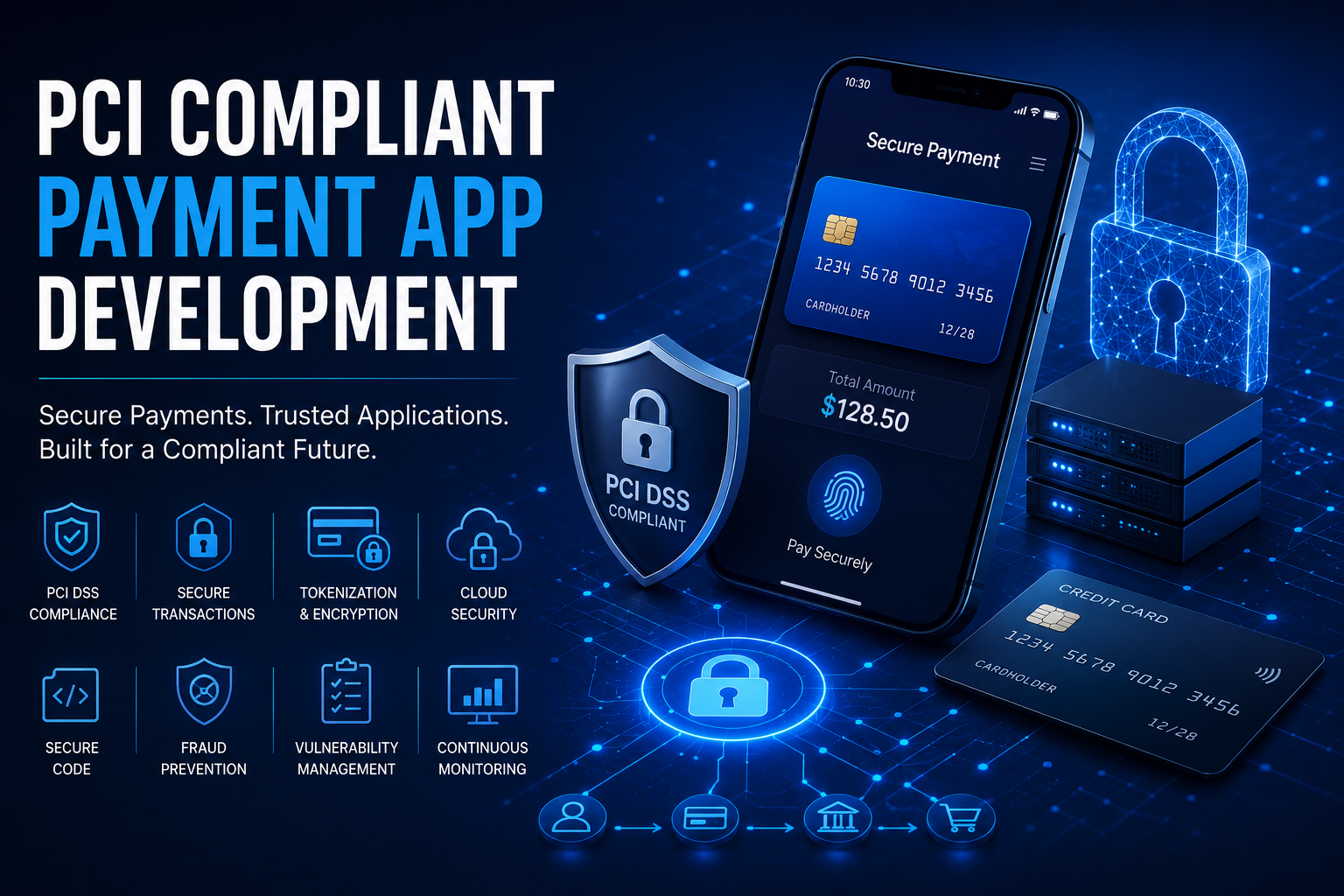
Digital payments have become a core part of modern business. From mobile wallets and payment applications to SaaS platforms, eCommerce systems, POS solutions, and subscription platforms, businesses increasingly depend on software to process and manage payment information.
But developing a payment application is very different from building an ordinary mobile or web application.
When an application handles payment card data, security and compliance must be considered from the beginning of the development process.
One of the most important frameworks businesses need to understand is the Payment Card Industry Data Security Standard (PCI DSS).
This guide explains what PCI-compliant payment app development involves, why PCI DSS matters, and how businesses can build secure payment applications without treating compliance as an afterthought.
What Is PCI DSS?
PCI DSS is a security standard designed to protect payment card data and reduce the risk of payment-related security breaches.
The standard applies to organizations that store, process, or transmit cardholder data, depending on their role within the payment ecosystem and applicable requirements.
PCI DSS focuses on areas such as:
- Network security
- Access control
- Data protection
- Secure software development
- Vulnerability management
- Monitoring and logging
- Security testing
- Authentication
- Incident response
The current PCI DSS version is PCI DSS 4.0.1, which provides updated requirements and clarifications for organizations handling payment card data.
For developers, this means security needs to be incorporated into the application’s architecture, code, infrastructure, testing, and deployment processes.
Why PCI Compliance Matters for Payment Applications
A payment application may handle highly sensitive information.
If payment information is improperly stored, transmitted, or exposed, businesses can face:
- Data breaches
- Financial losses
- Fraud
- Reputational damage
- Regulatory consequences
- Contractual penalties
- Loss of customer trust
PCI compliance helps organizations establish a structured security approach for protecting payment-related information.
However, PCI compliance should not be treated as a checkbox that is completed after development.
Security should be part of the application’s architecture from day one.
What Is PCI Compliant Payment App Development?
PCI compliant payment app development means designing and developing payment-related software using security controls and development practices appropriate to the application’s PCI scope.
This can involve:
- Secure application architecture
- Secure coding
- Encryption
- Tokenization
- Strong authentication
- Access controls
- Secure API development
- Vulnerability testing
- Logging and monitoring
- Secure infrastructure
- Security testing
- Documentation
The exact PCI requirements depend on the application’s role and how payment data flows through the environment.
Therefore, businesses should determine their PCI scope before deciding how the application should be designed.
Understanding PCI Scope
One of the most important decisions during payment application development is understanding PCI scope.
Consider a simplified payment flow:
Customer → Mobile App → Payment API → Payment Processor → Bank
If the application directly handles sensitive cardholder data, its PCI responsibilities can be substantially different from an application that uses a properly designed third-party hosted payment page or tokenization service.
Reducing unnecessary exposure to cardholder data can simplify the security architecture.
This is why payment architecture should be designed carefully before development begins.
Tokenization in Payment Applications
Tokenization is widely used in modern payment architectures.
Instead of repeatedly storing or transmitting sensitive card information, a payment system can use a token representing the payment method.
A simplified architecture could be:
Card Information → Secure Payment Provider → Token → Application
The application can then use the token for authorized payment operations without unnecessarily handling the underlying card information.
Tokenization can help reduce exposure to sensitive payment data, although it does not automatically eliminate PCI responsibilities.
The exact scope depends on the implementation and payment environment.
Encryption and Secure Data Transmission
Payment applications must protect sensitive information while it is being transmitted.
Secure communication typically involves:
- HTTPS
- TLS
- Secure APIs
- Strong authentication
- Certificate management
- Secure network configurations
Developers should avoid transmitting sensitive payment information through insecure channels.
Data protection should also be considered for information stored within databases, logs, backups, and monitoring systems.
Secure Payment Gateway Integration
Most modern businesses do not need to build an entire payment processing infrastructure from scratch.
Instead, they integrate established payment gateways or payment service providers.
A secure payment gateway integration may involve:
Customer → Application → Payment Gateway → Payment Processor → Bank
Developers need to carefully implement:
- API authentication
- Webhooks
- Transaction verification
- Error handling
- Refund workflows
- Payment status synchronization
- Idempotency
- Logging
- Secure credential management
Payment credentials and secret API keys should never be hard-coded into publicly distributed applications.
Mobile Payment App Security
Mobile payment applications require additional security considerations.
Developers should evaluate:
Secure Storage
Sensitive credentials should not be stored insecurely on the device.
Authentication
Applications can implement appropriate authentication mechanisms such as passwords, biometrics, multi-factor authentication, or secure session management.
API Security
The mobile application should communicate with backend services through properly authenticated and authorized APIs.
Application Integrity
Businesses should consider protections against tampering, reverse engineering, and unauthorized modification.
Secure Logging
Sensitive payment information should never accidentally appear in application logs.
Web Payment Application Security
Web-based payment applications also require careful security engineering.
Important areas include:
- HTTPS
- Secure cookies
- Session management
- Authentication
- Authorization
- Input validation
- API security
- Protection against common web vulnerabilities
- Secure headers
- Dependency management
- Vulnerability scanning
Developers should follow secure software development practices throughout the application lifecycle.
PCI-Compliant API Development
APIs are often the connection between payment applications and backend systems.
A payment API may handle:
- Customer information
- Payment requests
- Transaction status
- Refunds
- Payment tokens
- Webhooks
- Merchant information
A secure API architecture should include:
Authentication → Authorization → Validation → Processing → Secure Response → Logging
API endpoints should expose only the data and operations necessary for each user or service.
Secure Coding Practices
Secure coding should begin during development rather than after the application is finished.
Developers should consider:
- Input validation
- Output encoding
- Secure authentication
- Authorization checks
- Error handling
- Dependency security
- Secrets management
- Secure session management
- SQL injection prevention
- Cross-site scripting prevention
- API security
- Secure configuration
Code reviews and automated security testing can help identify vulnerabilities before production deployment.
Vulnerability Management
Payment applications should be continuously monitored for vulnerabilities.
A security program can include:
- Dependency scanning
- Static application security testing
- Dynamic application security testing
- Penetration testing
- Infrastructure vulnerability scanning
- Code reviews
- Security monitoring
- Patch management
Security isn’t a one-time activity.
New vulnerabilities can emerge after an application has already been deployed.
Logging and Monitoring
Security logs can help organizations identify suspicious behavior and investigate incidents.
A payment environment may need to monitor:
- Authentication events
- Administrative activity
- API access
- Configuration changes
- Security events
- Failed transactions
- Suspicious activity
However, logging must be designed carefully so that sensitive payment information is not unnecessarily recorded.
PCI DSS 4.0.1 and Modern Security
PCI DSS has evolved to reflect modern software development and security practices.
Organizations should not assume that simply following older PCI practices is sufficient.
Modern payment application development increasingly involves:
- Cloud infrastructure
- APIs
- Mobile applications
- DevOps
- CI/CD pipelines
- Third-party services
- Microservices
- Remote development teams
- Automated testing
Security controls therefore need to be integrated into the entire software development lifecycle.
DevSecOps for Payment Applications
For payment software, security should be integrated into development and deployment processes.
A DevSecOps workflow can look like:
Code → Automated Tests → Security Scan → Build → Vulnerability Check → Deployment → Monitoring
Security testing can be integrated into CI/CD pipelines so that vulnerabilities are identified before code reaches production.
This approach helps development teams maintain security without slowing down every release through entirely manual processes.
Cloud-Based Payment Applications
Cloud infrastructure can provide scalability and flexibility for payment applications, but cloud adoption does not automatically make an application PCI compliant.
Businesses still need to understand:
- Shared responsibility
- Identity management
- Network configuration
- Encryption
- Logging
- Access control
- Data storage
- Infrastructure security
- Cloud service configuration
The payment application’s architecture should clearly identify which security responsibilities belong to the application team, cloud provider, payment processor, and other service providers.
PCI Compliance and Third-Party Services
Modern payment applications often rely on third-party providers.
Examples include:
- Payment gateways
- Payment processors
- Cloud platforms
- Analytics services
- Fraud detection systems
- Customer support tools
- Authentication providers
Every external integration should be evaluated carefully.
Businesses need to understand what data is being transferred, why it is required, how it is protected, and how the service affects the application’s overall PCI environment.
Common PCI Compliance Mistakes
1. Treating Compliance as a Final Step
Waiting until the application is complete to address PCI requirements can result in expensive architectural changes.
2. Storing Unnecessary Card Data
Applications should avoid collecting or retaining sensitive payment information unless it is genuinely required.
3. Poor API Security
Weak authentication or excessive API permissions can expose sensitive systems.
4. Hard-Coded Secrets
API keys, passwords, and credentials should never be embedded directly in application source code.
5. Ignoring Logs
Sensitive payment information can accidentally appear in logs if logging is not carefully designed.
6. Using Outdated Dependencies
Old libraries can contain known vulnerabilities.
7. Inadequate Testing
Security testing should be performed throughout the software lifecycle.
How to Build a PCI-Compliant Payment Application
A practical development process can include the following stages.
Step 1: Define the Payment Architecture
Map the complete payment data flow.
Identify:
- Where payment information enters
- Where it travels
- Where it is processed
- Where it is stored
- Which third parties receive it
Step 2: Determine PCI Scope
Understand which components of the application and infrastructure are within the relevant PCI environment.
Step 3: Minimize Sensitive Data Exposure
Use appropriate payment providers, tokenization, and architectural techniques to reduce unnecessary handling of sensitive information.
Step 4: Build Secure APIs
Implement authentication, authorization, validation, rate limiting, secure communication, and appropriate monitoring.
Step 5: Implement Secure Coding
Use secure development standards throughout the application lifecycle.
Step 6: Perform Security Testing
Conduct appropriate automated and manual security testing.
Step 7: Document Security Controls
Maintain documentation for relevant architecture, processes, controls, and security procedures.
Step 8: Continuously Monitor
Security and compliance require ongoing management after launch.
Benefits of PCI-Compliant Payment Software
A properly designed secure payment application can provide:
Better Customer Trust
Customers expect businesses to protect their payment information.
Reduced Security Risk
Security controls can reduce the likelihood and impact of payment-related vulnerabilities.
Better Architecture
Security-first development often leads to stronger application architecture.
Easier Scaling
A well-designed payment infrastructure can support future growth.
Improved Business Reputation
Strong security practices can increase customer and partner confidence.
Who Needs PCI-Compliant Payment Application Development?
PCI-related security requirements may be relevant to businesses involved in:
- eCommerce
- Payment processing
- Fintech
- Digital wallets
- SaaS platforms
- Retail
- POS systems
- Subscription billing
- Marketplaces
- Mobile payments
- Financial applications
The exact obligations depend on the organization’s role in the payment ecosystem and applicable PCI requirements.
Why Choose a Specialized PCI Application Development Partner?
Payment application development combines software engineering with security and compliance requirements.
A development partner should understand:
- Mobile application development
- Web application development
- Payment gateway integration
- API development
- Cloud infrastructure
- Secure coding
- Encryption
- Tokenization
- Authentication
- Vulnerability management
- PCI DSS principles
The goal isn’t simply to create an application that processes payments.
The goal is to create a secure, scalable, maintainable payment ecosystem.
How PCIAppDevelopers Can Help
PCIAppDevelopers focuses on secure payment application development and integration for businesses that need to build or modernize payment-related software.
Services can include:
- PCI-focused application architecture
- Payment application development
- Mobile payment applications
- Web payment applications
- Payment gateway integration
- Secure API development
- Tokenization integration
- Cloud-based payment systems
- POS application development
- Security testing
- Secure software development
- Payment system modernization
By combining software engineering with payment-security considerations, businesses can develop applications designed around security from the beginning.
Frequently Asked Questions
What is PCI compliant payment app development?
PCI compliant payment app development involves designing and developing payment-related software with appropriate security controls and processes to protect payment card data and address applicable PCI DSS requirements.
Does every payment app need PCI compliance?
The answer depends on how the application handles payment card data and the organization’s role in the payment ecosystem. Businesses should determine their specific PCI scope rather than assuming every application has identical requirements.
Can a payment application avoid storing card data?
In many architectures, businesses can reduce exposure to sensitive card data by using payment providers, hosted payment components, tokenization, or other appropriate payment technologies.
Is tokenization enough for PCI compliance?
No. Tokenization can reduce exposure to sensitive payment data, but it does not automatically remove all PCI responsibilities.
How does payment gateway integration help?
A payment gateway can handle parts of the payment process and may help reduce the amount of sensitive card data directly handled by an application, depending on the integration architecture.
What is the latest PCI DSS version?
PCI DSS v4.0.1 is the current updated version of the standard. Organizations should consult the official PCI Security Standards Council documentation for applicable requirements.
How often should payment applications be security tested?
Testing requirements depend on the organization’s PCI scope, environment, and applicable controls. Security testing should also be integrated into the normal software development and vulnerability-management lifecycle.
The Future of Secure Payment Applications
Payment technology is evolving rapidly.
Modern payment applications increasingly combine:
Mobile + Web + APIs + Cloud + AI + Tokenization + Fraud Detection + Secure Payment Infrastructure
At the same time, customers expect payments to be fast, convenient, and secure.
Businesses therefore need to balance usability with strong security architecture.
PCI compliance should not be treated as a barrier to innovation.
Instead, it can become part of a broader strategy for building trustworthy digital payment products.
Build a Secure Payment Application
Developing payment software requires more than creating checkout screens and connecting a payment gateway.
The underlying architecture, APIs, data flows, authentication, infrastructure, monitoring, and security controls all matter.
PCIAppDevelopers helps businesses design and develop secure payment applications with PCI considerations built into the development process.
Planning a new payment application or modernizing an existing payment platform?
Build security into the architecture from day one.
Comments