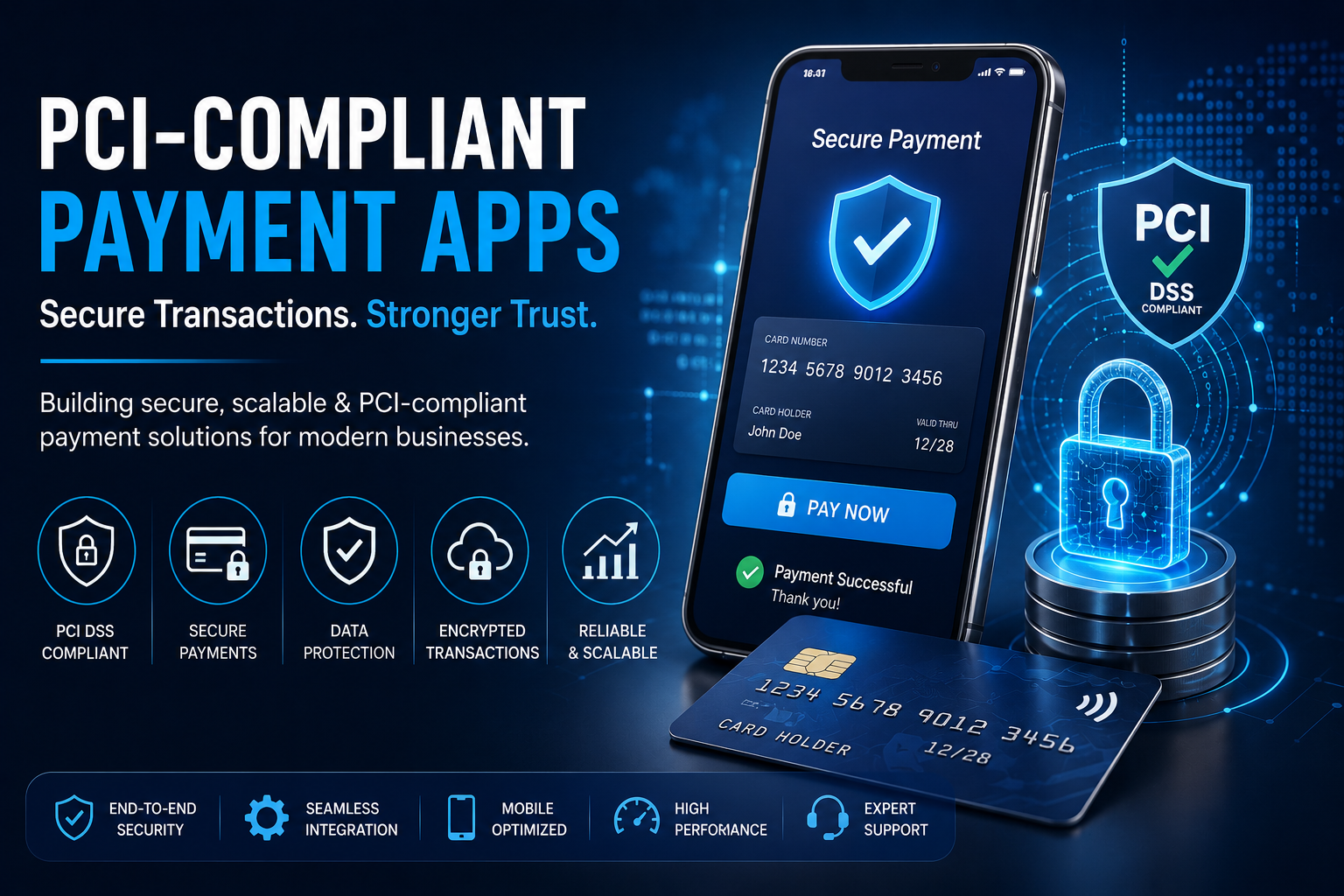
Digital payments have become a normal part of everyday business.
Customers pay through mobile apps, websites, point-of-sale systems, payment links, digital wallets, and connected devices. While these payment experiences are designed to be fast and convenient, they also involve sensitive payment information that must be protected.
For businesses that develop, manage, or integrate payment applications, security cannot be treated as an optional feature added at the end of development.
It must be considered from the beginning.
A secure payment application requires more than an attractive interface or a successful payment transaction. It needs strong security controls, secure integrations, responsible data handling, continuous testing, and alignment with relevant payment-security requirements.
At PCI App Developers, we help businesses build secure, scalable, and reliable payment applications designed around modern payment workflows and PCI security considerations.
What Is a PCI-Compliant Payment Application?
A PCI-compliant payment application is software designed to support payment processing while following applicable requirements from the Payment Card Industry Data Security Standard (PCI DSS).
PCI DSS provides security requirements intended to help protect payment account data.
Depending on how an application processes, stores, or transmits payment information, its security responsibilities may vary.
A payment application may include:
- Mobile payment applications
- E-commerce payment systems
- Point-of-sale software
- Payment gateways
- Subscription billing platforms
- Payment processing dashboards
- Digital wallet integrations
- Payment APIs
- Marketplace payment systems
PCI compliance is not a one-time software feature or a certificate that can simply be added to an application.
It is an ongoing security responsibility involving technology, processes, access controls, monitoring, testing, and operational practices.
Why Payment Application Security Matters
Payment applications often handle valuable information and are attractive targets for cybercriminals.
A security issue can lead to:
- Financial losses
- Customer trust problems
- Business disruption
- Legal and contractual consequences
- Increased security costs
- Reputational damage
A secure payment application can help businesses reduce unnecessary exposure and create a safer customer experience.
Security also supports business growth.
Customers are more likely to use digital payment services when they believe their information is handled responsibly.
PCI Compliance Is More Than a Checkbox
Some businesses assume that using a payment gateway automatically makes the entire application PCI compliant.
A payment service provider can reduce the amount of sensitive payment data handled directly by an application, but the business may still have security responsibilities.
The scope depends on factors such as:
- Whether payment card data enters the application
- Whether card data is stored
- How payment information is transmitted
- Which third-party payment services are used
- How systems are connected
- Who can access payment-related systems
The best approach is to reduce unnecessary exposure to sensitive payment information and design secure payment workflows from the beginning.
Core Elements of a Secure Payment Application
1. Secure Payment Architecture
Security should be included during planning and system design.
A secure architecture may consider:
- Data flow
- System boundaries
- Payment integrations
- User access
- API security
- Cloud infrastructure
- Logging and monitoring
- Risk management
Understanding how payment information moves through a system helps development teams identify potential security risks.
2. Tokenization
Tokenization replaces sensitive payment information with a non-sensitive reference value called a token.
The token can be used by authorized systems without exposing the original payment data in every transaction.
For example, a subscription application may store a payment token instead of storing full card information.
Tokenization can help reduce exposure, but it should be implemented using appropriate payment technologies and security controls.
3. Secure Payment Gateway Integration
Payment gateways help businesses process digital transactions.
A secure integration should consider:
- Secure API communication
- Authentication
- Payment status validation
- Webhook security
- Error handling
- Transaction monitoring
- Reliable retry processes
Payment integrations should be tested carefully to prevent transaction errors and unauthorized activity.
4. Encryption
Encryption helps protect sensitive information during transmission and storage.
A secure payment system may use encryption to protect data:
- Between the customer and application
- Between the application and payment provider
- Between internal services
- Within approved storage systems
Encryption should be supported by secure key management and appropriate access controls.
5. Strong Authentication
Payment systems should verify the identity of users and administrators.
Security measures may include:
- Multi-factor authentication
- Secure password policies
- Role-based access controls
- Session management
- Device verification
- Login monitoring
Administrative access should be limited to authorized users.
6. Secure APIs
APIs connect payment applications with payment gateways, banking services, business platforms, and mobile applications.
Secure API practices may include:
- Authentication and authorization
- Input validation
- Rate limiting
- Secure token management
- Request monitoring
- API access controls
An insecure API can expose sensitive systems even when the application interface appears secure.
7. Security Testing
Payment applications should be tested throughout the development lifecycle.
Testing may include:
- Code reviews
- Vulnerability assessments
- Penetration testing
- Security scanning
- API testing
- Authentication testing
- Dependency monitoring
Security testing should continue after launch because new vulnerabilities and risks can emerge over time.
Common Payment Application Security Risks
Insecure Data Storage
Storing unnecessary payment information increases security exposure.
Businesses should avoid storing sensitive payment data unless there is a valid business need and the required security controls are in place.
Weak Access Controls
Too many users with broad system permissions can increase risk.
Access should follow the principle of least privilege, meaning users receive only the permissions needed for their responsibilities.
Insecure Third-Party Integrations
Payment applications often rely on external services.
Third-party integrations should be evaluated for security, reliability, access controls, and ongoing support.
Poor Error Handling
Error messages should not expose sensitive technical details.
Secure applications provide useful information to users without revealing internal system information.
Outdated Software
Unpatched software, frameworks, libraries, and operating systems can create security vulnerabilities.
Regular updates and dependency management are important parts of secure application maintenance.
PCI Payment App Development Process
At PCI App Developers, secure payment development begins with understanding the complete payment workflow.
Step 1: Payment Workflow Discovery
We identify:
- How customers make payments
- Which payment methods are required
- Where payment information enters the system
- Which third-party services are involved
- What business systems need payment information
Step 2: Security and Scope Planning
Our team reviews application architecture, data flows, integration requirements, and security considerations.
The goal is to reduce unnecessary exposure and define a practical development approach.
Step 3: Secure Application Development
We develop custom payment applications with attention to:
- Secure coding practices
- Authentication
- Authorization
- API protection
- Data handling
- Application performance
- Scalability
Step 4: Payment Integration
We integrate payment services based on the project’s requirements.
This may include:
- One-time payments
- Recurring billing
- Subscription payments
- Marketplace payments
- Refund workflows
- Payment notifications
Step 5: Testing and Validation
The application is tested for functionality, performance, reliability, and security.
Step 6: Deployment and Ongoing Support
After deployment, payment applications require monitoring, updates, maintenance, and security improvements.
Payment Applications We Develop
PCI App Developers can support the development of:
- Custom Payment Applications
- Mobile Payment Apps
- Payment Gateway Integrations
- Secure E-Commerce Platforms
- POS Payment Software
- Subscription Billing Applications
- Payment Processing Dashboards
- Payment APIs
- Digital Wallet Applications
- Marketplace Payment Systems
- Payment Analytics Platforms
The Role of AI in Payment Security
Artificial intelligence can help businesses identify unusual patterns and improve payment monitoring.
AI-powered systems may support:
- Fraud-risk analysis
- Transaction pattern monitoring
- Unusual activity detection
- Automated security alerts
- Customer behavior analysis
- Operational insights
AI should support—not replace—appropriate security controls, human review, and responsible risk management.
How Secure Payment Apps Build Customer Trust
Customers may not see the security architecture behind a payment application, but they notice the results.
A secure and reliable experience can provide:
- Smooth payment processing
- Clear transaction status
- Reliable receipts
- Secure authentication
- Consistent performance
- Faster issue resolution
Trust is created through reliable experiences over time.
Businesses that invest in secure payment technology can strengthen customer relationships and support long-term growth.
Why Choose PCI App Developers?
PCI App Developers helps businesses create secure payment solutions designed around real business requirements.
Our services include:
- PCI-Focused Payment Application Development
- Secure Payment Software Development
- Payment Gateway Integration
- Mobile Payment App Development
- Custom POS Development
- Payment API Development
- E-Commerce Payment Integration
- Subscription Billing Solutions
- Payment System Modernization
- Security-Focused Application Testing
- Cloud Payment Solutions
We focus on creating payment applications that are practical, scalable, user-friendly, and designed with security considerations from the beginning.
Conclusion
Digital payments are growing, but convenience must be supported by security.
A successful payment application requires secure architecture, responsible data handling, strong authentication, protected APIs, reliable payment integrations, and continuous testing.
PCI compliance is not simply a final development step. It is an ongoing responsibility that should influence how payment software is designed, developed, deployed, and maintained.
At PCI App Developers, we help businesses build secure, scalable, and modern payment applications that support customer trust and long-term growth.
Planning a secure payment application? Connect with PCI App Developers to build a payment solution designed for security, performance, and scalability.
Comments