For over a decade, mobile applications have followed the same formula:
Download an app.
Create an account.
Log in.
Tap through menus.
Search for what you need.
Complete a task.
This approach has worked well—but it also creates friction. Every extra tap, form, or screen increases the chance that users abandon the experience.
The next generation of mobile innovation is moving toward something entirely different: Invisible Apps.
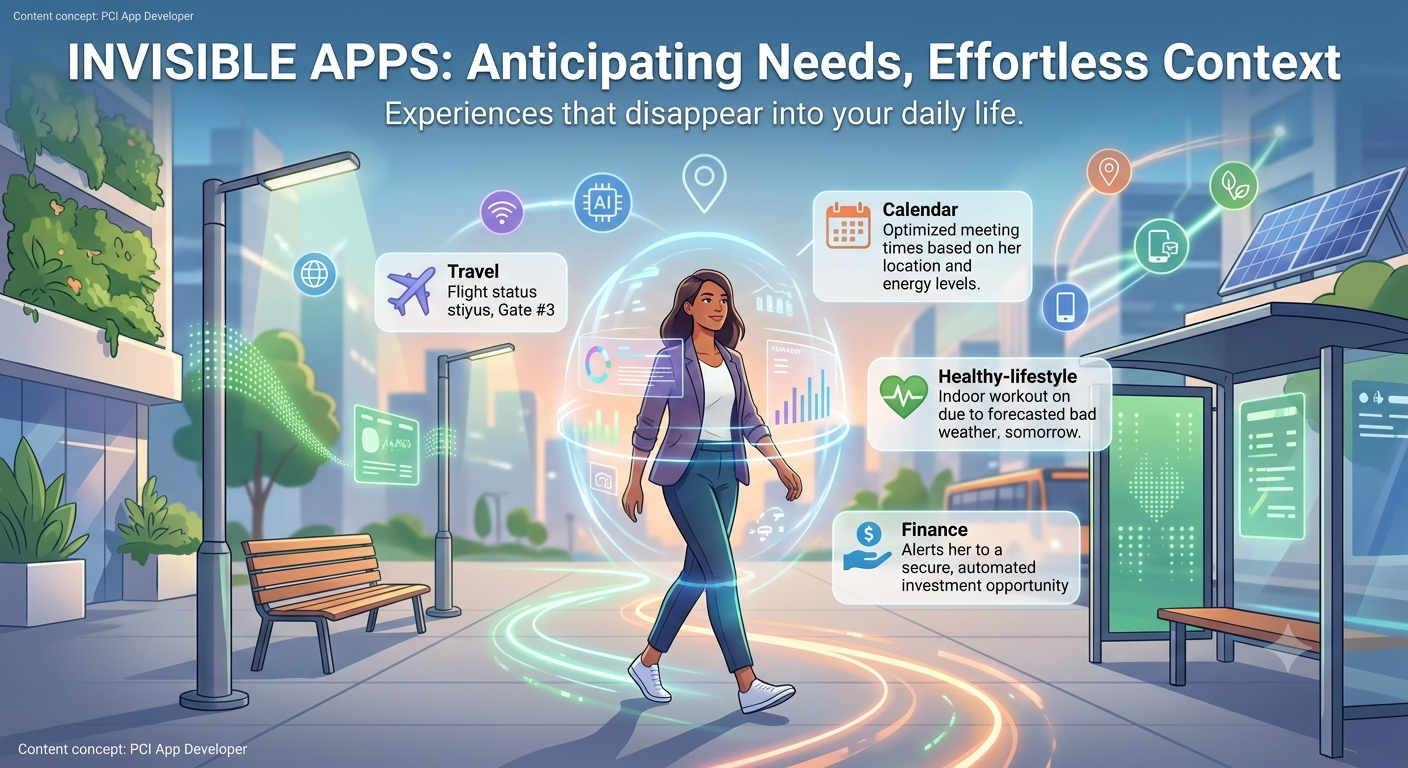
These aren’t apps that disappear from your phone—they’re experiences that disappear into your daily life. Instead of asking users to adapt to technology, they adapt to the user.
By 2030, the most successful mobile applications won’t compete on the number of features they have. They’ll compete on how effortlessly they anticipate user needs.
What Is an Invisible App?
An Invisible App is a digital experience that works in the background, using intelligence, context, and automation to minimize user effort.
Instead of requiring users to manually perform every action, the app understands:
- Where you are
- What you’re doing
- Your preferences
- Your schedule
- Your habits
- Connected devices
- Environmental conditions
- Previous interactions
The goal isn’t to remove user control—it’s to remove unnecessary work.
From User Interface to User Intent
Traditional mobile apps are built around interfaces.
Future apps will be built around intent.
Rather than asking users to navigate multiple screens, an app will recognize what they want to accomplish and offer it proactively.
Imagine opening a travel app. Instead of searching for your booking, it automatically displays today’s itinerary, boarding pass, weather forecast, airport traffic, and transportation options because it already understands your journey.
The app doesn’t wait for instructions—it understands the context.
Context-Aware Experiences
Context awareness is becoming one of the defining features of modern mobile applications.
Future apps will consider information such as:
- Time of day
- Device usage
- Location
- Calendar events
- Battery level
- Internet connectivity
- Nearby smart devices
- User behavior patterns
For example, a fitness app may suggest a short indoor workout if it detects bad weather outside, while a productivity app could automatically switch to “focus mode” during scheduled meetings.
These small adjustments create experiences that feel personalized without requiring constant user input.
AI Becomes Your Personal Digital Assistant
Artificial intelligence is evolving from a feature into the foundation of mobile applications.
Instead of simply responding to commands, AI-powered apps can:
- Draft emails
- Summarize documents
- Schedule appointments
- Recommend purchases
- Translate conversations
- Organize tasks
- Predict user preferences
- Automate repetitive workflows
The app becomes less of a tool and more of a digital assistant that helps users accomplish goals faster.
Voice, Gesture, and Conversation Replace Traditional Navigation
The future of mobile interaction extends beyond touchscreens.
Users will increasingly interact through:
- Natural voice conversations
- Smart gestures
- Wearable devices
- Augmented reality
- Eye tracking
- Context-sensitive notifications
Instead of tapping through multiple menus, users may simply say:
“Book my usual taxi for tomorrow morning.”
Or:
“Show me last month’s business expenses.”
The application understands the request and completes the task with minimal effort.
Apps That Learn and Improve Over Time
One-size-fits-all experiences are becoming outdated.
Future mobile applications continuously learn from user interactions.
They recognize:
- Frequently used features
- Preferred payment methods
- Navigation habits
- Communication style
- Shopping behavior
- Productivity patterns
As the app gathers insights, it reorganizes itself to match individual usage rather than forcing everyone into the same interface.
Multi-Device Experiences Without Interruptions
Today’s users switch between phones, tablets, laptops, smartwatches, TVs, and connected vehicles throughout the day.
The next generation of apps will provide seamless continuity across devices.
Start reading an article on your phone.
Continue on your tablet.
Reply to a notification from your smartwatch.
Complete a purchase from your laptop.
The experience remains consistent, with no manual synchronization required.
Privacy-First Personalization
As applications become smarter, user trust becomes even more important.
Modern mobile apps must balance personalization with privacy by:
- Minimizing unnecessary data collection
- Providing transparent permissions
- Encrypting sensitive information
- Supporting secure authentication
- Giving users control over their data
The future of app development isn’t about collecting more information—it’s about using data responsibly to create better experiences.
Edge AI: Intelligence Without Constant Internet
Many AI-powered features currently depend on cloud processing.
Edge AI changes this by performing intelligent tasks directly on the device.
Benefits include:
- Faster response times
- Reduced latency
- Improved privacy
- Lower bandwidth usage
- Offline functionality
Applications can deliver advanced capabilities even in environments with limited connectivity.
Designing for Human Attention
The average smartphone user receives dozens of notifications every day.
The best future apps won’t compete for attention—they’ll respect it.
Instead of sending constant alerts, intelligent apps will:
- Group notifications
- Prioritize important updates
- Delay non-essential messages
- Deliver information at the right moment
Reducing digital noise leads to a more satisfying user experience.
Industry Applications of Invisible Apps
The Invisible App concept extends across multiple industries:
Healthcare
Apps monitor health metrics in the background, remind patients about medications, and alert caregivers when necessary.
Retail
Shopping experiences become personalized with real-time recommendations, smart loyalty programs, and frictionless checkout.
Finance
Banking apps detect unusual spending, automate savings, and provide proactive financial insights.
Logistics
Delivery applications optimize routes, monitor vehicle performance, and update customers automatically.
Enterprise
Business apps automate approvals, summarize meetings, and simplify collaboration across distributed teams.
Why Businesses Should Invest Now
Customer expectations are changing rapidly.
Users increasingly expect applications that are:
- Fast
- Intelligent
- Personalized
- Secure
- Available across devices
- Easy to use
- Integrated with AI
Businesses that embrace these principles today will be better positioned to deliver competitive digital products tomorrow.
Future-ready applications are not built overnight—they require thoughtful architecture, scalable technology, and user-centered design from the beginning.
How PCI App Developer Builds Future-Ready Mobile Applications
At PCI App Developer, we believe mobile applications should do more than complete tasks—they should simplify lives.
Our development approach combines:
- Native and cross-platform app development
- AI-powered features
- Cloud integration
- Secure architecture
- API development
- IoT connectivity
- Real-time analytics
- Scalable backend systems
- Modern UI/UX design
- Enterprise-grade performance
We create applications designed for today’s users while preparing businesses for tomorrow’s digital landscape.
Conclusion
The future of mobile apps isn’t about adding more buttons, menus, or features.
It’s about creating experiences that understand people, adapt to changing contexts, and reduce complexity.
The most successful applications of the next decade will become almost invisible—working quietly in the background while helping users achieve more with less effort.
Businesses that begin building these intelligent, context-aware experiences today will lead the next era of mobile innovation.
Comments