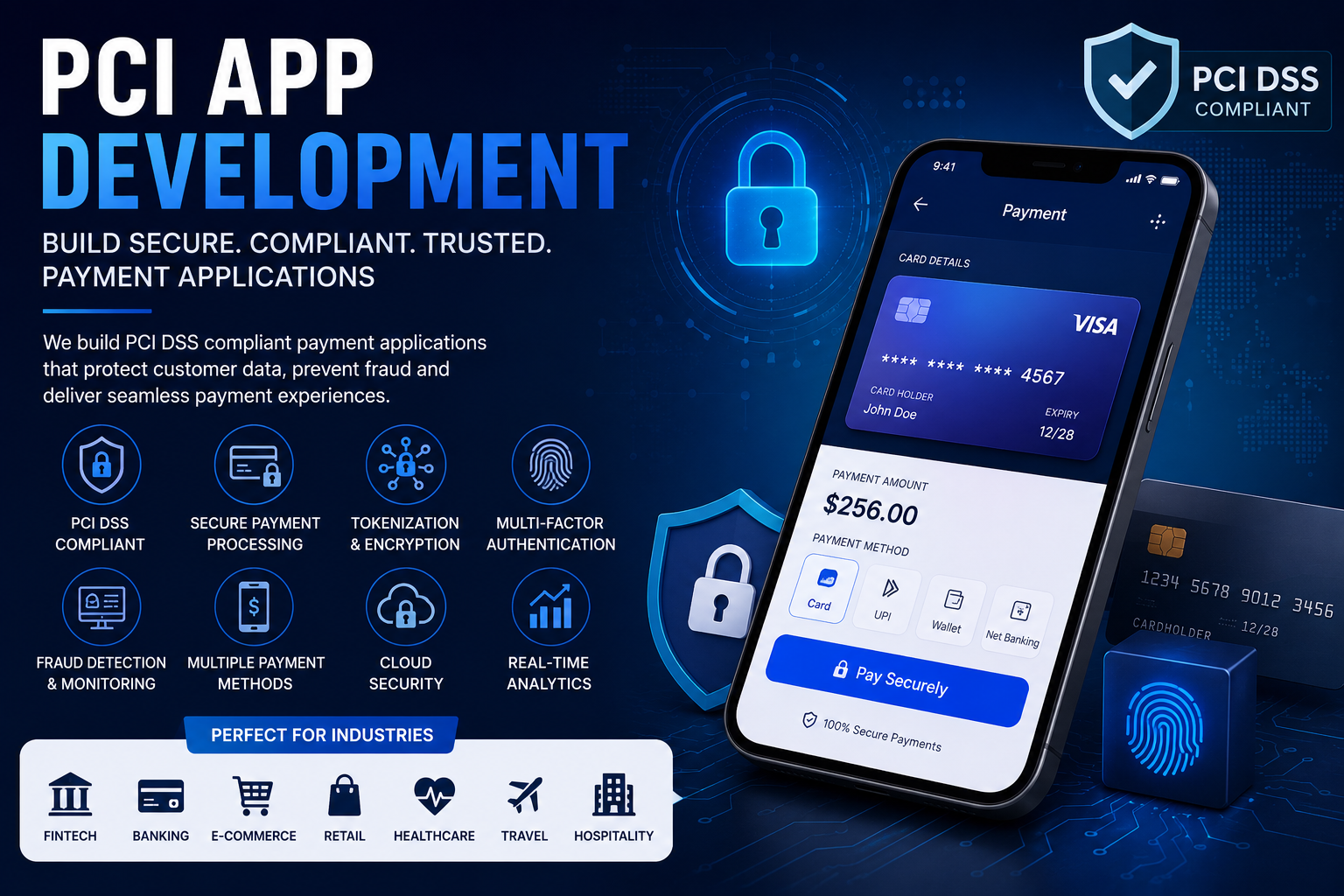
As digital payments continue to dominate global commerce, businesses must ensure that every transaction is secure. Customers expect fast, seamless, and protected payment experiences, while organizations must comply with strict industry regulations to safeguard sensitive cardholder data.
This is where PCI App Development plays a critical role.
Whether you’re building a mobile wallet, payment gateway, POS application, eCommerce platform, banking app, or FinTech solution, developing applications that align with PCI DSS (Payment Card Industry Data Security Standard) is essential for protecting customer information, reducing fraud, and maintaining trust.
In this comprehensive guide, we’ll explore what PCI app development is, why PCI compliance matters, key features, technologies, and how businesses can build secure payment applications that scale with confidence.
What Is PCI App Development?
PCI App Development refers to the design and development of software applications that securely process, transmit, or store payment card information while following PCI DSS security standards.
These applications are commonly used in:
- Mobile Payment Apps
- Digital Wallets
- eCommerce Platforms
- POS Systems
- Banking Applications
- FinTech Platforms
- Subscription Billing Systems
- Online Marketplaces
- Payment Gateways
- Enterprise Payment Solutions
The primary objective is to ensure that sensitive payment data remains protected throughout every transaction.
Why PCI Compliance Matters
Every business that accepts credit or debit card payments is responsible for protecting customer payment information.
Failure to follow PCI DSS standards can lead to:
- Data breaches
- Financial fraud
- Regulatory penalties
- Legal liabilities
- Loss of customer trust
- Brand reputation damage
A PCI-compliant application minimizes these risks while ensuring secure payment processing across all platforms.
Benefits of PCI App Development
1. Enhanced Data Security
PCI-compliant applications use advanced security measures such as:
- End-to-end encryption
- Tokenization
- Secure APIs
- Data masking
- Strong authentication
These features significantly reduce the risk of unauthorized access.
2. Customer Trust
Customers are more likely to complete transactions when they know their payment information is secure.
A secure payment experience improves:
- Customer confidence
- Brand loyalty
- Conversion rates
- User retention
3. Regulatory Compliance
PCI-compliant applications help organizations meet industry requirements, reducing the risk of penalties and audit failures.
4. Reduced Fraud
Advanced fraud detection mechanisms include:
- AI-powered risk analysis
- Device fingerprinting
- Transaction monitoring
- Behavioral analytics
- Suspicious activity alerts
5. Scalable Payment Infrastructure
PCI applications are designed to support:
- High transaction volumes
- Global payment processing
- Multiple currencies
- Multi-region deployments
- Cloud scalability
Essential Features of PCI-Compliant Applications
A modern PCI payment application should include:
Secure Authentication
- Multi-factor authentication (MFA)
- Biometric login
- Face ID
- Fingerprint authentication
- Secure password policies
Payment Processing
- Credit Card Payments
- Debit Card Payments
- Contactless Payments
- NFC Transactions
- QR Code Payments
- Mobile Wallet Integration
Encryption & Tokenization
Instead of storing raw card data, PCI applications:
- Encrypt sensitive information
- Replace card numbers with secure tokens
- Protect payment information during transmission
User Management
- Customer Profiles
- Transaction History
- Payment Methods
- Saved Cards
- Account Settings
Fraud Prevention
Security mechanisms include:
- AI fraud detection
- Velocity checks
- Risk scoring
- Geo-location monitoring
- IP analysis
- Suspicious login detection
Industries That Require PCI App Development
Banking
Banks use PCI-compliant applications for:
- Digital banking
- Card management
- Online payments
- Fund transfers
FinTech
FinTech companies develop:
- Mobile wallets
- Buy Now Pay Later (BNPL)
- Peer-to-peer payments
- Merchant payment platforms
Retail
Retail businesses require secure payment systems for:
- Online shopping
- In-store POS
- Subscription payments
- Loyalty programs
Healthcare
Healthcare providers process secure patient payments while protecting financial and personal information.
Hospitality
Hotels and travel businesses use PCI applications for:
- Reservations
- Online bookings
- Contactless check-ins
- Payment processing
PCI App Development Process
A successful PCI application typically follows these stages:
Requirement Analysis
Understand:
- Business goals
- Payment workflows
- Compliance requirements
- Security risks
UI/UX Design
Create intuitive interfaces for:
- Customers
- Merchants
- Administrators
Secure Development
Develop features using secure coding standards and industry best practices.
Payment Gateway Integration
Integrate trusted payment providers such as:
- Stripe
- PayPal
- Square
- Authorize.Net
- Adyen
- Braintree
Security Testing
Perform:
- Penetration testing
- Vulnerability assessments
- API security testing
- Performance testing
- Compliance validation
Deployment & Monitoring
Deploy the application using secure cloud infrastructure with continuous monitoring and updates.
Technologies Used in PCI App Development
Mobile
- Android
- iOS
- Flutter
- React Native
Frontend
- React.js
- Angular
- Vue.js
Backend
- .NET
- Java
- Node.js
- Python
- Spring Boot
Databases
- PostgreSQL
- MySQL
- SQL Server
- MongoDB
Cloud Platforms
- AWS
- Microsoft Azure
- Google Cloud Platform
Security Technologies
- TLS Encryption
- OAuth 2.0
- JWT Authentication
- Tokenization
- AES-256 Encryption
- HSM (Hardware Security Modules)
AI in PCI Payment Applications
Artificial Intelligence enhances payment security by enabling:
- Real-time fraud detection
- Intelligent transaction monitoring
- Customer behavior analysis
- Risk-based authentication
- Automated compliance reporting
- Predictive fraud prevention
These capabilities help businesses respond to threats proactively.
Why Choose QuartusTech for PCI App Development?
At QuartusTech, we build secure, scalable, and PCI-focused payment applications for businesses worldwide.
Our expertise includes:
- PCI DSS–aligned application development
- Payment gateway integration
- Mobile payment applications
- POS software development
- Digital wallet solutions
- FinTech platforms
- NFC payment integration
- QR payment applications
- AI-powered fraud detection
- Cloud-native payment systems
Our experienced developers follow secure coding practices and modern architectures to deliver reliable payment applications that support business growth while prioritizing customer trust.
Future Trends in PCI App Development
The future of payment applications includes:
- AI-driven fraud prevention
- Contactless payments
- Biometric authentication
- Embedded finance
- Blockchain-based payments
- Open Banking APIs
- IoT payment devices
- Wearable payment technology
- Voice-enabled payments
- Real-time payment networks
Businesses adopting these technologies today will be better positioned for the next generation of digital commerce.
Conclusion
PCI app development is no longer optional for organizations handling payment card information. Building secure, compliant, and scalable payment applications helps businesses protect customer data, reduce fraud, meet regulatory requirements, and deliver exceptional payment experiences.
Whether you’re launching a FinTech platform, upgrading an existing payment solution, or developing a next-generation POS system, investing in PCI-focused application development is essential for long-term success.
Partner with QuartusTech to build secure payment applications that combine compliance, innovation, and performance.
Comments